min cifre dispari
(Punti 2) Adele ha scritto un numero formato da 3 cifre dispari e alcune cifre pari, Marco ha scritto un nu mero formato da 2 cifre dispari e alcune cifre pari. Gianna ha sommato il numero di Adele a quello di Marco. Quante cifre dispari avrà al minimo il numero ottenuto da Gianna? A) 0 (cioè può non averne) B) 1 C) 2 D) 3 E) 4
Topic: Teoria dei Numeri Metodo: congruenze Abilita: Casework accurato Area: Aritmetica e Teoria dei Numeri Fonte: apri PDF p.1
min odd numbers
Adele wrote a number consisting of 3 odd numbers and some even numbers, while Marco wrote a number consisting of 2 odd numbers and some even numbers. Gianna added Adele’s number to Marco’s. How many odd numbers will Gianna get at least? A) 0 (i.e. it may not have) B) 1 C) 2 D) 3 E) 4
src_kangourou_2023_benjamin_semifinale__Q01
somma Renata tripla di Gabriele, numero scartato
\begin{document}
\begin{tikzpicture}
  \draw[thick] (0,0) rectangle (3,3);
  \draw[thick] (1,0) -- (1,3);
  \draw[thick] (2,0) -- (2,3);
  \draw[thick] (0,1) -- (3,1);
  \draw[thick] (0,2) -- (3,2);
  \node at (0.5,2.5) {1};
  \node at (1.5,2.5) {2};
  \node at (2.5,2.5) {3};
  \node at (0.5,1.5) {4};
  \node at (1.5,1.5) {5};
  \node at (2.5,1.5) {6};
  \node at (0.5,0.5) {7};
  \node at (1.5,0.5) {8};
  \node at (2.5,0.5) {9};
\end{tikzpicture}
\end{document}
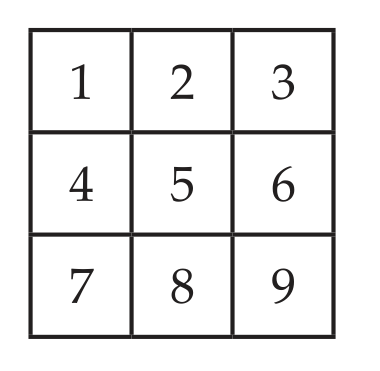
(Punti 3) Osserva la griglia a destra in cui sono riportati i numeri interi da 1 a 9. Gabriele ha scelto 4 di questi numeri, Renata ne ha scelti altri 4. La somma dei numeri scelti da Renata è il triplo della somma dei numeri scelti da Gabriele. Qual è il numero che nessuno dei due ha scelto? A) 1 B) 5 C) 7 D) 8 E) 9
Topic: Teoria dei Numeri Abilita: Conteggio sistematico Area: Aritmetica e Teoria dei Numeri Fonte: apri PDF p.1
Sum of Gabriele’s triple renata, number discarded
\begin{document}
\begin{tikzpicture}
  \draw[thick] (0,0) rectangle (3,3);
  \draw[thick] (1,0) -- (1,3);
  \draw[thick] (2,0) -- (2,3);
  \draw[thick] (0,1) -- (3,1);
  \draw[thick] (0,2) -- (3,2);
  \node at (0.5,2.5) {1};
  \node at (1.5,2.5) {2};
  \node at (2.5,2.5) {3};
  \node at (0.5,1.5) {4};
  \node at (1.5,1.5) {5};
  \node at (2.5,1.5) {6};
  \node at (0.5,0.5) {7};
  \node at (1.5,0.5) {8};
  \node at (2.5,0.5) {9};
\end{tikzpicture}
\end{document}
(Points 3) See the grid on the right where the integers from 1 to 9 are shown. Gabriele picked four of these numbers, Renata picked four more. The sum of the numbers chosen by Renata is three times the sum of the numbers chosen by Gabriele. What’s the number neither of you picked? A) 1 B) 5 C) 7 D) 8 E) 9
src_kangourou_2023_benjamin_semifinale__Q02
min carte da rovesciare
(Punti 3) Aldo possiede cinque carte: per ognuna di esse su una faccia c’è una lettera dell’alfabeto, sulla faccia opposta un numero intero. Le carte sono disposte sul tavolo e mostrano le seguenti facce: E, G, 4, 7, 8. Aldo dichiara che, per ogni carta, se su una delle facce c’è una vocale, su quella opposta c’è un numero pari. Marta vuole controllare se Aldo dice la verità, ma vuole rovesciare il minor numero possibile di carte. Quante carte dovrà rovesciare al massimo? A) 1 B) 2 C) 3 D) 4 E) 5
Topic: Logica, giochi, strategie Metodo: Analisi per casi Abilita: Lettura attenta del testo Area: Combinatoria, Logica e Probabilita Fonte: apri PDF p.1
min cards to be rolled over
(Points 3) Aldo has five cards: for each of them on one face there is a letter of the alphabet, on the opposite face an integer. The cards are placed on the table and show the following faces: E, G, 4, 7, 8. Aldo declares that, for each card, if on one face there is a vowel, on the opposite face there is an equal number. Marta wants to check if Aldo’s telling the truth, but she wants to roll as few cards as possible. How many cards will he have to roll at most? A) 1 B) 2 C) 3 D) 4 E) 5
src_kangourou_2023_benjamin_semifinale__Q03
colonna di 2023
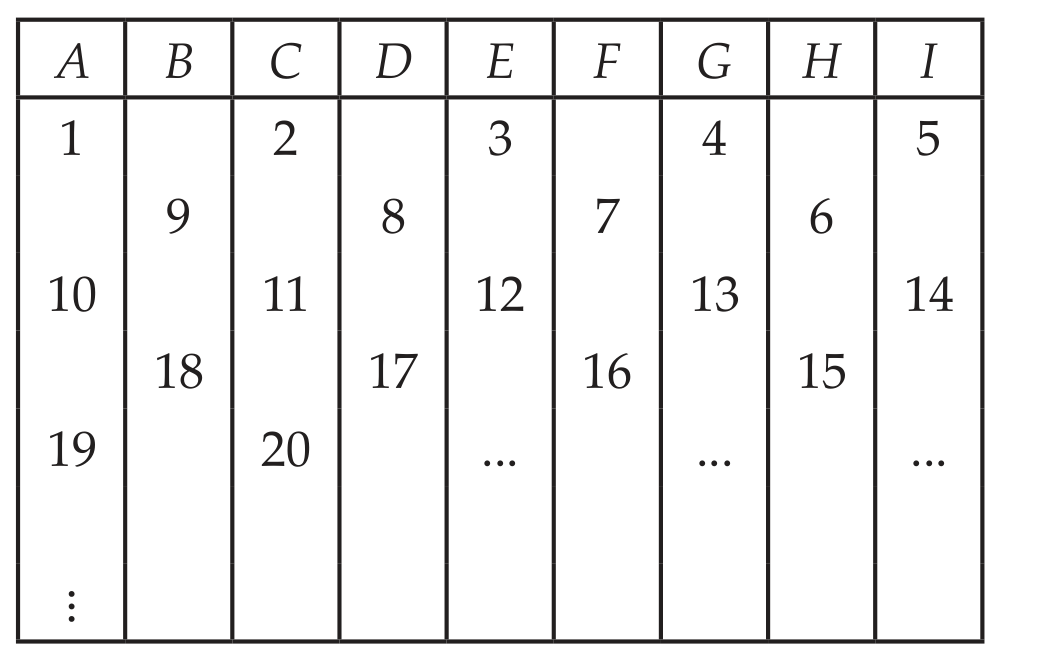
(Punti 4) I numeri interi da 1 a 9.000 sono stati inseriti in una enorme tabella a 9 colonne secondo il criterio indicato in figura. In quale colonna è stato inserito il numero 2.023? A) A B) D C) F D) H E) I
Topic: Teoria dei Numeri Metodo: congruenze Abilita: Riconoscimento di pattern Area: Aritmetica e Teoria dei Numeri Fonte: apri PDF p.1
This item is intended to record the information provided for in the Annex to this Regulation.
(Points 4) The integers 1 to 9,000 were placed in a huge 9-column table according to the criterion shown in the figure. In which column is the number 2.023 entered? A) A B) D C) F D) H E) I
src_kangourou_2023_benjamin_semifinale__Q04
orario
(Punti 4) In una centrale vi sono due guardiani. Vi sono anche due segnalatori acustici di sicurezza: uno emette uno squillo ogni due minuti, l’altro lo emette ogni tre. Quando squillano contemporaneamente si sen te uno squillo solo. Alle 12:00 hanno squillato contemporaneamente e vi era un solo guardiano nella centrale; quando il secondo dei guardiani è entrato nella centrale, hanno squillato ancora contemporaneamente e, dal le 12:00 a quell’istante inclusi, il primo guardiano, sempre presente, ha udito 13 squilli. A che ora il secondo guardiano è entrato nella centrale? A) 12:12 B) 12:15 C) 12:18 D) 12:24 E) 12:30
Topic: Teoria dei Numeri Metodo: congruenze Abilita: traduzione del testo Area: Aritmetica e Teoria dei Numeri Fonte: apri PDF p.1
The time of the meeting shall be: *
There are two guards in a power station. There are also two safety sound signals: one rings every two minutes, the other rings every three minutes. When they ring at the same time, you feel a single ring. At 12:00 they rang at the same time and there was only one guard in the station; when the second guard entered the station, they rang again at the same time and, from 12:00 noon onwards, the first guard, always present, heard 13 bells. What time did the second guard enter the station? A) 12:12 B) 12:15 C) 12:18 D) 12:24 E) 12:30
src_kangourou_2023_benjamin_semifinale__Q05
differenza possibile
(Punti 4) Clara ha scritto un numero intero di tre cifre, Dalia ha scritto il numero che ha le stesse cifre di quello di Clara, ma scritte in ordine opposto (cioè, nei due numeri, la cifra delle centinaia e quella delle unità sono scambiate fra loro, mentre quella delle decine è la stessa). Quale, fra quelli elencati nelle risposte, può essere la differenza fra il numero di Clara e quello di Dalia?
A) 378 B) 295 C) 196 D) 495 E) 504
Topic: Teoria dei Numeri Metodo: congruenze Abilita: Manipolazione algebrica Area: Aritmetica e Teoria dei Numeri Fonte: apri PDF p.1
possible difference
Clara wrote an integer number of three digits, Dalia wrote the number that has the same digits as Clara’s, but written in opposite order (i.e., in the two numbers, the number of hundreds and that of units are exchanged between them, while that of tens is the same). Which of the answers listed could be the difference between Clara’s number and Dalia’s? A) 378 B) 295 C) 196 D) 495 E) 504
src_kangourou_2023_benjamin_semifinale__Q06
giro di Bill
\begin{document}
\begin{tikzpicture}
  \draw[thick] (0,0) circle(2.5);
  \node[draw, circle, inner sep=1.5pt, minimum size=16pt, fill=white] (n1) at (0.000,2.500) {\small 1};
  \node[draw, circle, inner sep=1.5pt, minimum size=16pt, fill=white] (n2) at (1.162,2.214) {\small 2};
  \node[draw, circle, inner sep=1.5pt, minimum size=16pt, fill=white] (n3) at (2.057,1.420) {\small 3};
  \node[draw, circle, inner sep=1.5pt, minimum size=16pt, fill=white] (n4) at (2.482,0.301) {\small 4};
  \node[draw, circle, inner sep=1.5pt, minimum size=16pt, fill=white] (n5) at (2.338,-0.887) {\small 5};
  \node[draw, circle, inner sep=1.5pt, minimum size=16pt, fill=white] (n6) at (1.658,-1.871) {\small 6};
  \node[draw, circle, inner sep=1.5pt, minimum size=16pt, fill=white] (n7) at (0.598,-2.427) {\small 7};
  \node[draw, circle, inner sep=1.5pt, minimum size=16pt, fill=white] (n8) at (-0.598,-2.427) {\small 8};
  \node[draw, circle, inner sep=1.5pt, minimum size=16pt, fill=white] (n9) at (-1.658,-1.871) {\small 9};
  \node[draw, circle, inner sep=1.5pt, minimum size=16pt, fill=white] (n10) at (-2.338,-0.887) {\small 10};
  \node[draw, circle, inner sep=1.5pt, minimum size=16pt, fill=white] (n11) at (-2.482,0.301) {\small 11};
  \node[draw, circle, inner sep=1.5pt, minimum size=16pt, fill=white] (n12) at (-2.057,1.420) {\small 12};
  \node[draw, circle, inner sep=1.5pt, minimum size=16pt, fill=white] (n13) at (-1.162,2.214) {\small 13};
\end{tikzpicture}
\end{document}
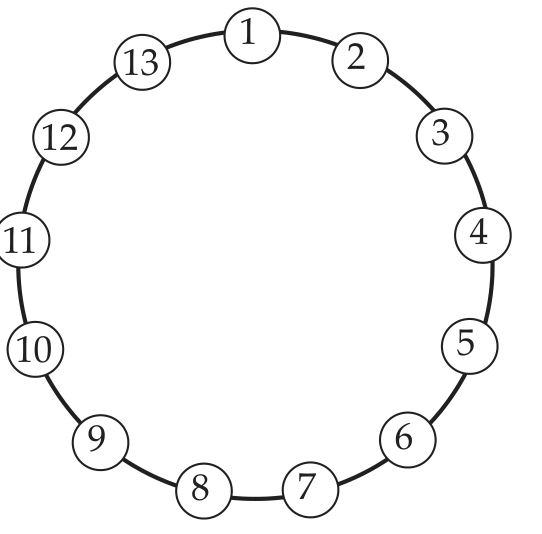
(Punti 5) Lungo una pista circolare sono poste delle piazzole numerate come in figura; la distanza tra due piazzole adiacenti è sempre la stessa. Due canguri Bill e Kan saltano da una piazzola a quella adiacente, Bill in verso orario, Kan nel verso opposto, ciascuno a velocità costante, ma diversa: infatti sono partiti nello stesso istante dalla piazzola 1 e si sono incrociati per la prima volta quan do entrambi sono arrivati sulla piazzola 6. Si sa che prima o poi si incroceranno entrambi sulla piazzola 7: quando ciò accadrà per la prima volta, quale giro di pista starà facendo Bill?
A) Il primo. B) Il secondo. C) Il terzo. D) Il quarto. E) Il quinto. A B C D E F G H I 1 2 3 4 5 9 8 7 6 10 11 12 13 14 18 17 16 15 19 20 … … …
Topic: Logica, giochi, strategie Metodo: congruenze Abilita: Ragionamento geometrico Area: Combinatoria, Logica e Probabilita Fonte: apri PDF p.1
This is the first time I’ve seen this.
\begin{document}
\begin{tikzpicture}
  \draw[thick] (0,0) circle(2.5);
  \node[draw, circle, inner sep=1.5pt, minimum size=16pt, fill=white] (n1) at (0.000,2.500) {\small 1};
  \node[draw, circle, inner sep=1.5pt, minimum size=16pt, fill=white] (n2) at (1.162,2.214) {\small 2};
  \node[draw, circle, inner sep=1.5pt, minimum size=16pt, fill=white] (n3) at (2.057,1.420) {\small 3};
  \node[draw, circle, inner sep=1.5pt, minimum size=16pt, fill=white] (n4) at (2.482,0.301) {\small 4};
  \node[draw, circle, inner sep=1.5pt, minimum size=16pt, fill=white] (n5) at (2.338,-0.887) {\small 5};
  \node[draw, circle, inner sep=1.5pt, minimum size=16pt, fill=white] (n6) at (1.658,-1.871) {\small 6};
  \node[draw, circle, inner sep=1.5pt, minimum size=16pt, fill=white] (n7) at (0.598,-2.427) {\small 7};
  \node[draw, circle, inner sep=1.5pt, minimum size=16pt, fill=white] (n8) at (-0.598,-2.427) {\small 8};
  \node[draw, circle, inner sep=1.5pt, minimum size=16pt, fill=white] (n9) at (-1.658,-1.871) {\small 9};
  \node[draw, circle, inner sep=1.5pt, minimum size=16pt, fill=white] (n10) at (-2.338,-0.887) {\small 10};
  \node[draw, circle, inner sep=1.5pt, minimum size=16pt, fill=white] (n11) at (-2.482,0.301) {\small 11};
  \node[draw, circle, inner sep=1.5pt, minimum size=16pt, fill=white] (n12) at (-2.057,1.420) {\small 12};
  \node[draw, circle, inner sep=1.5pt, minimum size=16pt, fill=white] (n13) at (-1.162,2.214) {\small 13};
\end{tikzpicture}
\end{document}
(Points 5) Numbered pitches are placed along a circular track, the distance between two adjacent pitches being always the same. Two kangaroos, Bill and Kan, jump from one slot to the next, Bill clockwise, Kan the other way, each at a steady but different speed: they left slot 1 at the same moment and crossed for the first time when they both arrived at slot 6. You know, sooner or later, they’re both gonna cross paths on floor seven. When that happens for the first time, which track is Bill going to be doing? A) The first. (b) The second. (c) The third. D) The fourth. E) The fifth. A B C D E F G H I 1 2 3 4 5 9 8 7 6 10 11 12 13 14 18 17 16 15 19 20 … … …
src_kangourou_2023_benjamin_semifinale__Q07
quale ora dà l’angolo acuto minore
(Punti 5) In quale delle seguenti ore e minuti le due lancette di un orologio (con un quadrante di 12 ore) formano l’angolo acuto minore? A) 02:11 B) 04:22 C) 06:33 D) 08:44 E) 10:55
Topic: Geometria piana Abilita: Ragionamento geometrico Area: Geometria Fonte: apri PDF p.2
which now gives the minor acute angle
(Points 5) In which of the following hours and minutes do the two hands of a clock (with a 12-hour dial) form the minor acute angle? A) 02:11 B) 04:22 C) 06:33 D) 08:44 E) 10:55
src_kangourou_2023_benjamin_semifinale__Q08
Numeri <40 con somma dei quadrati delle cifre quadrato
(Punti 6) Quanti numeri interi positivi minori di 40 hanno la proprietà che la somma dei quadrati delle loro due cifre è essa stessa un quadrato perfetto? (I numeri vanno pensati comunque di due cifre, ad esempio 4 va pensato scritto come 04.) A) 1 B) 9 C) 12 D) 13 E) 14 Quesiti a risposta aperta
Topic: Teoria dei Numeri Metodo: Conteggio combinatorio Abilita: Casework accurato Area: Aritmetica e Teoria dei Numeri Fonte: apri PDF p.2
Numbers <40 with sum of squares of the square digits
(Points 6) How many positive integers less than 40 have the property that the sum of the squares of their two digits is itself a perfect square? (Numbers must be thought of as two digits anyway, for example 4 must be thought of as 04.) A) 1 B) 9 C) 12 D) 13 E) 14 Open-ended questions
src_kangourou_2023_benjamin_semifinale__Q09
totale famiglia
(Punti 4) Ho tanti fratelli quante sorelle. Per ognuno dei miei fratelli, accade che il numero delle sue sorel le è il doppio del numero dei suoi fratelli. Con mamma e papà, in quanti siamo in famiglia?
Topic: Teoria dei Numeri Abilita: traduzione del testo Area: Aritmetica e Teoria dei Numeri Fonte: apri PDF p.2
total family
I have as many brothers as I have sisters. For each of my brothers, it happens that the number of his sisters is twice the number of his brothers. With Mom and Dad, how many of us are in the family?
src_kangourou_2023_benjamin_semifinale__Q10
altezza e bisettrice, angolo ACB
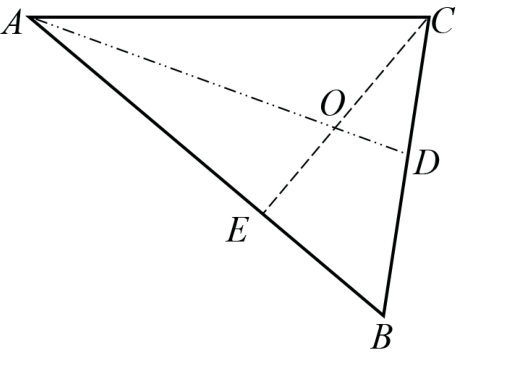
(Punti 5) Nel triangolo ABC in figura, l’altezza EC condotta da C incontra la biset trice AD dell’angolo BAC nel punto O. L’angolo ABC misura 60 gradi, l’angolo AOE ne misura 70. Quanti gradi misura l’angolo ACB?
Topic: Geometria piana Abilita: Ragionamento geometrico Area: Geometria Fonte: apri PDF p.2
height and width, angle ACB
(Points 5) In the ABC triangle shown in the figure, the EC height of C meets the AD biset of the BAC angle at O. The ABC angle is 60 degrees, the AOE angle is 70. How many degrees does the ACB angle measure?
src_kangourou_2023_benjamin_semifinale__Q11
quanti bastano per il disegno
\begin{document}
\begin{tikzpicture}
  \draw[thick] (0,0) rectangle (3,3);
  \draw[thick] (1,0) -- (1,3);
  \draw[thick] (2,0) -- (2,3);
  \draw[thick] (0,1) -- (3,1);
  \draw[thick] (0,2) -- (3,2);
\end{tikzpicture}
\end{document}
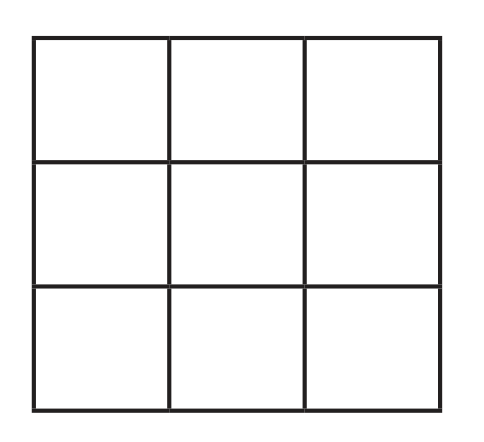
(Punti 5) Con un pennarello nero, Lorenzo ha disegnato su un foglio di carta tra sparente 10 quadrati di lato 1 cm, 10 quadrati di lato 2 cm e 10 quadrati di lato 3 cm e poi li ha ritagliati (i bordi sono rimasti ben visibili dopo il taglio). Ora deve usarne alcuni per ottenere lo stesso disegno che compare in figura. Per eseguire questo com pito può accostarli o sovrapporli parzialmente. Quanti gliene bastano?
Topic: Geometria piana Abilita: Conteggio sistematico Area: Geometria Fonte: apri PDF p.2
how much is enough for the drawing
\begin{document}
\begin{tikzpicture}
  \draw[thick] (0,0) rectangle (3,3);
  \draw[thick] (1,0) -- (1,3);
  \draw[thick] (2,0) -- (2,3);
  \draw[thick] (0,1) -- (3,1);
  \draw[thick] (0,2) -- (3,2);
\end{tikzpicture}
\end{document}
With a black pencil, Lorenzo drew on a sheet of paper 10 squares of 1 cm side, 10 squares of 2 cm side and 10 squares of 3 cm side and then cut them (the edges remained clearly visible after cutting). Now you have to use some of them to get the same drawing that appears in the figure. In order to perform this task, they may be brought close together or partially overlapped. How many are enough for you?
src_kangourou_2023_benjamin_semifinale__Q12
pere non usate
(Punti 6) Avevo 10 mele di pesi diversi fra loro e 10 pere di pesi diversi fra loro. Ogni pera pesava più di ogni mela, ma meno di una qualunque coppia di mele. Sono stato fortunato e sono riuscito a confezionare tre sacchetti misti, in ognuno dei quali il complesso delle pere pesa quanto il complesso delle mele. Certamente non avrei potuto sperare di utilizzare più pere di quelle che ho utilizzato. Quante pere non ho utilizzato?
Topic: Logica, giochi, strategie Metodo: Principio di estremalita Abilita: Casework accurato Area: Combinatoria, Logica e Probabilita Fonte: apri PDF p.2
not used
I had 10 apples of different weights between them and 10 pairs of different weights between them. Each pear weighed more than every apple, but less than any pair of apples. I was lucky enough to pack three mixed bags, each of which weighs as much as the whole of the apples. Certainly I could not have hoped to use more pears than I did. How many pears have I not used?
src_kangourou_2023_benjamin_semifinale__Q13
peso Maurizio
(Punti 6) Maurizio e Carlo hanno ciascuno una scatola di palline. Ogni pallina pesa un numero intero di grammi; in ognuna delle scatole, le palline hanno tutte lo stesso peso, ma quelle della scatola di Maurizio sono più leggere di quelle della scatola di Carlo. Moltiplicando il peso di una pallina di Maurizio per quello di una pallina di Carlo si ottiene 81; sommando i pesi di tutte le palline si ottiene 1001. Quanti grammi pesa ognuna delle palline di Maurizio?
Topic: Teoria dei Numeri Metodo: manipolazione algebrica Abilita: Manipolazione algebrica Area: Aritmetica e Teoria dei Numeri Fonte: apri PDF p.2
weight Mauritius
(Points 6) Maurizio and Carlo each have a box of balls. Each ball weighs a whole number of grams; in each of the boxes, the balls all have the same weight, but those in Maurizio’s box are lighter than those in Charles’ box. Multiplying the weight of a Maurizio’s ball by that of a Carlo’s ball gets 81; adding up the weights of all the balls gets 1001. How many grams each of Maurizio’s balls weighs?
src_kangourou_2023_benjamin_semifinale__Q14
n sia 23
(Punti 6) Quanti sono i numeri interi positivi n tali che il resto della divisione 2023 : n sia 23?
Topic: Teoria dei Numeri Metodo: congruenze Abilita: Casework accurato Area: Aritmetica e Teoria dei Numeri Fonte: apri PDF p.2
n is 23
(Points 6) How many positive integers are n such that the remainder of division 2023: n is 23?
src_kangourou_2023_benjamin_semifinale__Q15
quanti
(Punti 7) Alcuni numeri, tutti diversi fra loro, sono scritti in corrispondenza di punti distinti di una cir conferenza in modo che ognuno sia il prodotto dei due numeri scritti a esso adiacenti. Quanti sono i numeri scritti?
Topic: Algebra Metodo: Ricorsione Abilita: Riconoscimento di pattern Area: Algebra e Analisi Fonte: apri PDF p.2
*how many *
(Points 7) Some numbers, all different from each other, are written at different points in a conference so that each number is the product of the two numbers written next to it. How many numbers are written?
src_kangourou_2023_benjamin_semifinale__Q16
trova n
(Punti 7) Gaia gioca così. Scrive un numero intero n, poi lo moltiplica a caso o per 5 o per 6. Al prodotto somma a caso o 5 o 6. Alla somma sottrae a caso o 5 o 6. Se il risultato finale è 78, che numero è n?
Topic: Teoria dei Numeri Metodo: Analisi per casi Abilita: Manipolazione algebrica Area: Aritmetica e Teoria dei Numeri Fonte: apri PDF p.2
Find n *
That’s how Gaia plays. He writes an integer n, then he multiplies it randomly or by 5 or by 6. To the product, the random sum is either 5 or 6. At the sum, he randomly subtracts five or six. If the end result is 78, what number is n?
src_kangourou_2023_benjamin_semifinale__Q17
somma cifre eliminabili
(Punti 8) È dato il numero 7 2 3 1 1 2 3 7 7 2 1 3 7 3 2 1: da esso si vuole eliminare esattamente una cifra e ottenere dall’allineamento di cifre rimanenti (una in meno di prima) un nuovo numero che risulti divisibile per 9. Vi sono diversi modi di farlo. Qual è la somma delle cifre che possono essere eliminate al variare dei modi possibili?
Topic: Teoria dei Numeri Metodo: congruenze Abilita: Casework accurato Area: Aritmetica e Teoria dei Numeri Fonte: apri PDF p.2
sum of removable figures
(Points 8) The number 7 2 3 1 1 2 3 7 2 1 3 7 2 1 3 3 2 1 is given: from it you want to eliminate exactly one digit and get from the alignment of the remaining digits (one less than the previous one) a new number that is divisible by 9. There’s a lot of different ways to do that. What is the sum of the numbers that can be eliminated in varying ways?