Differenza tra numero di tre cifre e quello a cifre invertite
(Punti 2) Clara ha scritto un numero intero di tre cifre, Dalia ha scritto il numero che ha le stesse cifre di quello di Clara, ma scritte in ordine opposto (cioè, nei due numeri, la cifra delle centinaia e quella delle unità sono scambiate fra loro, mentre quella delle decine è la stessa). Quale, fra quelli elencati nelle risposte, può essere la differenza fra il numero di Clara e quello di Dalia?
A) 378 B) 295 C) 196 D) 495 E) 504
Topic: Teoria dei Numeri Metodo: manipolazione algebrica Abilita: Manipolazione algebrica Area: Aritmetica e Teoria dei Numeri Fonte: apri PDF p.1
Difference between a three-digit number and an inverted number
(Points 2) Clara wrote an integer number of three digits, Dalia wrote the number that has the same digits as Clara’s, but written in opposite order (i.e., in the two numbers, the hundreds digit and the units digit are exchanged, while the tens digit is the same). Which of the answers listed could be the difference between Clara’s number and Dalia’s? A) 378 B) 295 C) 196 D) 495 E) 504
Frazione colorata di una finestra con semicerchi e quarti di cerchio
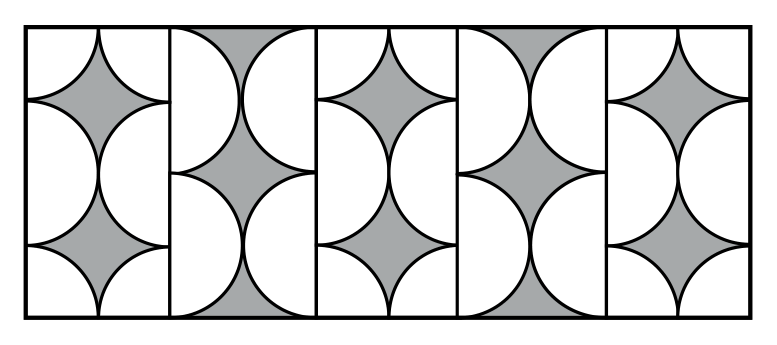
(Punti 3) In figura vedete una finestra decorata. Semicerchi e quarti di cerchio che vi compaiono non colorati hanno tutti lo stesso raggio. Della superficie dell’intera finestra, quale frazione è stata colorata? (Considerate di area nulla i tratti divisori e i bordi.) A) π/4 B) (π – 3)/4 C) 1 – π/4 D) (3π/4) – 1
E) (4 – π)/2
Topic: Geometria piana Abilita: Ragionamento geometrico Area: Geometria Fonte: apri PDF p.1
Colored fraction of a window with semicircles and quarter circles
(Points 3) In the figure you see a decorated window. Half-circles and quarter-circles that you see that appear uncolored all have the same radius. From the surface of the entire window, what fraction has been coloured? (Consider the dividing lines and edges as having no area.) A) π/4 B) (π – 3)/4 C) 1 – π/4 D) (3π/4) – 1 E) (4 – π)/2
Quanti interi <40 con somma dei quadrati delle cifre quadrato perfetto
(Punti 3) Quanti numeri interi positivi minori di 40 hanno la proprietà che la somma dei quadrati delle loro due cifre è essa stessa un quadrato perfetto? (I numeri vanno pensati comunque di due cifre, ad esempio 4 va pensato scritto come 04.) A) 1 B) 9 C) 12 D) 13 E) 14
Topic: Teoria dei Numeri Metodo: Analisi per casi Abilita: Conteggio sistematico Area: Aritmetica e Teoria dei Numeri Fonte: apri PDF p.1
Integers <40 whose sum of squares of digits is a perfect square
(Points 3) How many positive integers less than 40 have the property that the sum of the squares of their two digits is itself a perfect square? (Numbers must be thought of as two digits anyway, for example 4 must be thought of as 04.) A) 1 B) 9 C) 12 D) 13 E) 14
tentativi massimi noti i vincoli sulle cifre
(Punti 4) Il codice di una cassetta di sicurezza è un numero di quattro cifre. La somma delle ultime due è un numero primo di due cifre che, lette nell’ordine, sono le prime due cifre del codice. Disponendo soltanto di queste informazioni, quanti tentativi saranno necessari, al massimo, per aprire la cassetta? A) 4 B) 8 C) 12 D) 16 E) 20
Topic: Teoria dei Numeri, Combinatoria Metodo: Conteggio combinatorio Abilita: Conteggio sistematico Area: Aritmetica e Teoria dei Numeri, Combinatoria, Logica e Probabilita Fonte: apri PDF p.1
maximum attempts given the constraints on digits
The code of a safe deposit box is a four digit number. The sum of the last two is a prime number of two digits which, read in the order, are the first two digits of the code. With only this information, how many attempts will it take, at most, to open the box? A) 4 B) 8 C) 12 D) 16 E) 20
Minima somma di tre numeri TAP, BAT, CAD con cifre distinte
(Punti 4) Sono dati tre numeri interi ciascuno di tre cifre (cioè la prima cifra di ciascuno non può essere 0) che denotiamo con TAP, BAT e CAD dove ogni lettera rappresenta una cifra, lettere diverse cifre diverse. Qual è il più piccolo valore possibile per la somma di questi tre numeri? A) 600 B) 610 C) 615 D) 730 E) 732
Topic: Teoria dei Numeri Abilita: Casework accurato Area: Aritmetica e Teoria dei Numeri Fonte: apri PDF p.1
Minimum sum of three numbers TAP, BAT, CAD with distinct digits
(Points 4) Three whole numbers are given each of three digits (i.e. the first digit of each cannot be 0) which we denote with TAP, BAT and CAD where each letter represents a digit, different letters are different digits. What’s the smallest possible value for the sum of these three numbers? A) 600 B) 610 C) 615 D) 730 E) 732
Somma cifre del prodotto di 9 numeri di cifre 2 o 3 tra 600 e 1200
(Punti 4) Il prodotto di 9 numeri interi scritti utilizzando esclusivamente le cifre 2 e/o 3 è un numero com preso fra 600 e 1200. Qual è la somma delle cifre di questo prodotto? A) 18 B) 21 C) 23 D) 25 E) Esiste più di una possibilità.
Topic: Teoria dei Numeri Metodo: Analisi per casi Abilita: Conteggio sistematico Area: Aritmetica e Teoria dei Numeri Fonte: apri PDF p.1
sum of the digits of the product of 9 numbers with digits 2 or 3 between 600 and 1200
The product of 9 integers written using only the digits 2 and/or 3 is a number between 600 and 1200. What is the sum of the digits of this product? A) 18 B) 21 C) 23 D) 25 E) There is more than one possibility.
Numero massimo di parti tagliando tre sfere con due piani
(Punti 5) Tre sfere di raggio 1 sono disposte nello spazio in modo che i loro centri formino un triangolo equilatero di lato 3. Qual è il maggior numero di parti nelle quali il complesso delle tre sfere può essere ripar tito tagliando le sfere con due piani? A) 8 B) 9 C) 10 D) 11 12) 12
Topic: Geometria solida Metodo: Analisi per casi Abilita: Ragionamento geometrico Area: Geometria Fonte: apri PDF p.1
Maximum number of parts by cutting three spheres with two planes
(Points 5) Three spheres of radius 1 are arranged in space so that their centers form an equilateral triangle of side 3. What is the largest number of parts in which the three spheres can be divided by cutting the spheres with two planes? A) 8 B) 9 C) 10 D) 11 E) 12
Segno di m e n affinche una espressione sia intera
(Punti 5) Si sa che i tre numeri m, n e (8m × 102m) / (5 – m – n × 203m) sono tutti interi e diversi da zero. Quale delle seguenti affermazioni è vera? A) m < 0, n > 0 B) m > 0, n > 0 C) m > 0, n < 0 D) m < 0, n < 0 E) m + n ≥ 0
Topic: Algebra, Teoria dei Numeri Metodo: manipolazione algebrica Abilita: Manipolazione algebrica Area: Algebra e Analisi, Aritmetica e Teoria dei Numeri Fonte: apri PDF p.1
Sign of m and n for an expression to be an integer
(Points 5) It is known that the three numbers m, n and (8m × 102m) / (5 – m – n × 203m) are all integers and not zero. Which of the following statements is true? A) m < 0, n > 0 B) m > 0, n > 0 C) m > 0, n < 0 D) m < 0, n < 0 E) m + n ≥ 0
in quale vivono i mentitori
(Punti 6) Un villaggio ha 5 case, ogni abitante vive in una di queste 5 case e in ognuna vive qualcuno. Tutti gli abitanti che vivono in 4 di esse dicono sempre la verità, tutti gli abitanti che vivono nella casa rimanente mentono sempre. Passando di casa in casa sono state raccolte le seguenti dichiarazioni: Casa A: “In questa casa vivono 3 persone”, “In questo villaggio vivono più di 17 persone”. Casa B: “In questa casa vivono 4 persone”, “In questo villaggio vivono più di 21 persone”. Casa C: “In questa casa vivono 5 persone”, “Il numero di persone che vivono in questo villaggio NON è 25”. Casa D: “In questa casa vivono 6 persone”, “In questo villaggio vivono meno di 29 persone”. Casa E: “In questa casa vivono 7 persone”, “In questo villaggio vivono meno di 33 persone”. In quale casa vivono i mentitori? A) Nella casa A. B) Nella casa B. C) Nella casa C. D) Nella casa D. E) Nella casa E.
Quesiti a risposta aperta
Topic: Logica, giochi, strategie Metodo: Analisi per casi Abilita: Casework accurato Area: Combinatoria, Logica e Probabilita Fonte: apri PDF p.1
Where lies live.
A village has 5 houses, each resident lives in one of these 5 houses and in each one lives someone. All the inhabitants living in four of them always tell the truth, all the inhabitants living in the remaining house always lie. The following statements were collected from house to house: House A: “In this house live 3 people”, “In this village live more than 17 people”. House B: “In this house live 4 people”, “In this village live more than 21 people”. House C: “In this house live 5 people”, “The number of people living in this village is NOT 25”. House D: “In this house there are 6 people”, “In this village there are less than 29 people”. House E: “In this house live 7 people”, “In this village live less than 33 people”. What house do liars live in? A) In house A. B) In house B. C) In house C. D) In house D. E) In house E.
Open-ended questions
Peso palline di Maurizio dati prodotto 81 e somma 1001
(Punti 4) Maurizio e Carlo hanno ciascuno una scatola di palline. Ogni pallina pesa un numero intero di grammi; in ognuna delle scatole, le palline hanno tutte lo stesso peso, ma quelle della scatola di Maurizio sono più leggere di quelle della scatola di Carlo. Moltiplicando il peso di una pallina di Maurizio per quello di una pallina di Carlo si ottiene 81; sommando i pesi di tutte le palline si ottiene 1001. Quanti grammi pesa ognuna delle palline di Maurizio?
Topic: Teoria dei Numeri Metodo: manipolazione algebrica Abilita: Manipolazione algebrica Area: Aritmetica e Teoria dei Numeri Fonte: apri PDF p.2
Maurizio’s ball weights given product 81 and sum 1001
Maurizio and Carlo each have a box of balls. Each ball weighs a whole number of grams; in each of the boxes, the balls all have the same weight, but those in Maurizio’s box are lighter than those in Carlo’s box. Multiplying the weight of one of Maurizio’s balls by that of one of Carlo’s balls gives 81; adding up the weights of all the balls gives 1001. How many grams does each of Maurizio’s balls weigh?
Conteggio inserimenti lettere in 5 settori con A,B non adiacenti
\begin{document}
\begin{tikzpicture}[scale=1.5]
  \draw (0,0) circle (1);
  \draw (0,0) -- (90:1);
  \draw (0,0) -- (18:1);
  \draw (0,0) -- (-54:1);
  \draw (0,0) -- (-126:1);
  \draw (0,0) -- (162:1);
  \node at (54:0.65) {1};
  \node at (-18:0.65) {2};
  \node at (-90:0.65) {3};
  \node at (198:0.65) {4};
  \node at (126:0.65) {5};
\end{tikzpicture}
\end{document}
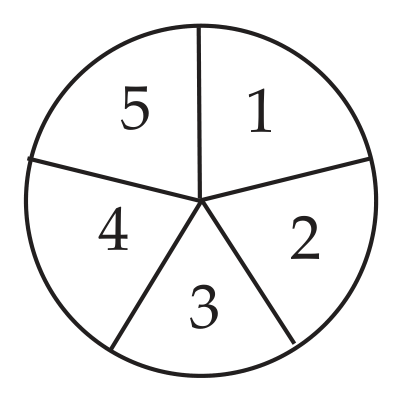
(Punti 5) In ognuno dei cinque settori numerati nei quali è ripartito il cerchio in figu ra, va inserita una delle lettere A, B, C, D, E (lettere diverse per settori diversi), in modo che le lettere A e B non si trovino in settori adiacenti. In quanti diversi modi si può effet tuare l’inserimento?
Topic: Combinatoria Metodo: Conteggio combinatorio Abilita: Conteggio sistematico Area: Combinatoria, Logica e Probabilita Fonte: apri PDF p.2
Counting entries in 5 sectors with non-adjacent A,B
\begin{document}
\begin{tikzpicture}[scale=1.5]
  \draw (0,0) circle (1);
  \draw (0,0) -- (90:1);
  \draw (0,0) -- (18:1);
  \draw (0,0) -- (-54:1);
  \draw (0,0) -- (-126:1);
  \draw (0,0) -- (162:1);
  \node at (54:0.65) {1};
  \node at (-18:0.65) {2};
  \node at (-90:0.65) {3};
  \node at (198:0.65) {4};
  \node at (126:0.65) {5};
\end{tikzpicture}
\end{document}
In each of the five numbered sectors into which the circle is divided, one of the letters A, B, C, D, E (different letters for different sectors) must be inserted so that the letters A and B are not in adjacent sectors. In how many different ways can the insertion be carried out?
Trovare n dopo operazioni casuali con risultato 78
(Punti 5) Gaia gioca così. Scrive un numero intero n, poi lo moltiplica a caso o per 5 o per 6. Al prodotto somma a caso o 5 o 6. Alla somma sottrae a caso o 5 o 6. Se il risultato finale è 78, che numero è n?
Topic: Algebra Metodo: Ragionamento all’indietro Abilita: Manipolazione algebrica Area: Algebra e Analisi Fonte: apri PDF p.2
Find n after random operations with result 78*
Gaia plays like this. He writes an integer n, then he multiplies it randomly or by 5 or by 6. To the product he randomly adds either 5 or 6. From the sum he randomly subtracts either 5 or 6. If the end result is 78, what number is n?
Somma cifre eliminabili per rendere il numero divisibile per 9
(Punti 6) È dato il numero 7 2 3 1 1 2 3 7 7 2 1 3 7 3 2 1: da esso si vuole eliminare esattamente una cifra e ottenere dall’allineamento di cifre rimanenti (una in meno di prima) un nuovo numero che risulti divisibile per 9. Vi sono diversi modi di farlo. Qual è la somma delle cifre che possono essere eliminate al variare dei modi possibili?
Topic: Teoria dei Numeri Metodo: congruenze Abilita: Conteggio sistematico Area: Aritmetica e Teoria dei Numeri Fonte: apri PDF p.2
Sum of digits that can be removed to make the number divisible by 9
(6 points) The number 7 2 3 1 1 2 3 7 7 2 1 3 7 3 2 1 is given: from it we want to remove exactly one digit and obtain, from the alignment of the remaining digits (one fewer than before), a new number that is divisible by 9. There are several ways to do this. What is the sum of the digits that can be removed over the various possible ways?
Piu piccolo primo p>2 con p^3+7p^2 quadrato perfetto
(Punti 6) Qual è il più piccolo intero primo p > 2 tale che il numero p3 + 7p2 sia un quadrato perfetto?
Topic: Teoria dei Numeri Metodo: manipolazione algebrica Abilita: Manipolazione algebrica Area: Aritmetica e Teoria dei Numeri Fonte: apri PDF p.2
Smallest prime p>2 with p^3+7p^2 perfect square
(Points 6) What is the smallest prime integer p > 2 such that the number p3 + 7p2 is a perfect square?
Valore di A-B con somme di quadrati e prodotti consecutivi
(Punti 6) Sia A la somma dei quadrati di tutti i numeri interi positivi da 1 a 2.023 inclusi e sia B = (1 × 3) + (2 × 4) + (3 × 5) + … + (2.022 × 2.024). Quanto vale A – B?
Topic: Algebra, Teoria dei Numeri Metodo: Somme telescopiche Abilita: Manipolazione algebrica Area: Algebra e Analisi, Aritmetica e Teoria dei Numeri Fonte: apri PDF p.2
A-B value with sums of squares and consecutive products
(Points 6) Let A be the sum of the squares of all positive integers from 1 to 2,023 included and let B = (1 × 3) + (2 × 4) + (3 × 5) + … + (2.022 × 2.024). How much is A – B?
Minimo k con (x^2+y^2+z^2)^2 <= k(x^4+y^4+z^4)
(Punti 7) Qual è il più piccolo numero reale k tale che la disuguaglianza (x2 + y2 + z2)2 ≤ k (x4 + y4 + z4) valga per ogni terna {x, y, z} di numeri reali?
Topic: Disuguaglianze Metodo: Disuguaglianze classiche Abilita: Manipolazione algebrica Area: Algebra e Analisi Fonte: apri PDF p.2
Minimum k with (x^2+y^2+z^2)^2 <= k(x^4+y^4+z^4)
(Points 7) What is the smallest real number k such that the inequality (x2 + y2 + z2) 2 ≤ k (x4 + y4 + z4) holds for every triple {x, y, z} of real numbers?
Prodotto di due numeri tolti da 1..17 uguale alla somma dei restanti
(Punti 7) Dall’insieme dei numeri interi tra 1 e 17, questi inclusi, si possono levare due numeri in modo che il loro prodotto coincida con la somma dei rimanenti e vi è un solo modo per farlo. Quanto vale tale prodotto?
Topic: Teoria dei Numeri Metodo: manipolazione algebrica Abilita: Conteggio sistematico Area: Aritmetica e Teoria dei Numeri Fonte: apri PDF p.2
Product of two numbers removed from 1..17 equal to the sum of the remaining ones
(7 points) From the set of integers between 1 and 17, these included, one can remove two numbers so that their product coincides with the sum of the remaining ones and there is only one way to do it. What is the value of this product?
Intero piu vicino a p dato rapporto perimetri quadrato smussato
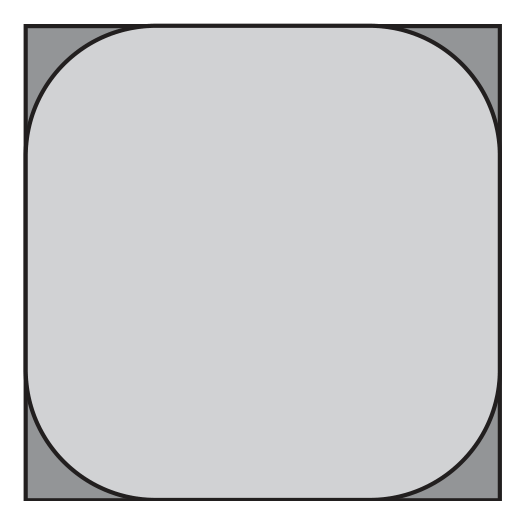
(Punti 8) Gli angoli di un quadrato vengono smussati con archi circolari, tutti dello stesso raggio, come indica la figura; la parte rettilinea del bordo della nuova regione è lunga quanto la parte curva. Il rapporto fra il perimetro della nuova fi gura e il perimetro del quadrato originario è il numero p/100. Qual è l’intero più vicino a p? 1 5 2 3 4
Topic: Geometria piana Abilita: Ragionamento geometrico Area: Geometria Fonte: apri PDF p.2
Interest closer to p given square perimeter ratio
The angles of a square are moved with circular arcs, all of the same radius, as shown in the figure; the straight side of the edge of the new region is as long as the curved side. The ratio of the perimeter of the new figure to the perimeter of the original square is p/100. What is the nearest integer to p? 1 5 2 3 4