Numero di cioccolatini regalati a tre figli
(Punti 2) La mamma ha regalato ai suoi tre figli dei cioccolatini, lo stesso numero a tutti. Quando ognuno ne ha mangiati 6, si sono resi conto che, complessivamente, i cioccolatini rimasti sono tanti quanti ciascuno ne aveva ricevuti dalla mamma. Qual è il numero di cioccolatini che la mamma ha regalato in totale? A) 27 B) 48 C) 36 D) 21 E) 22 Risposta: A). Soluzione. Il numero cercato deve essere tale che, sottraendogli 18, si ottenga un terzo del numero stesso.
Topic: Teoria dei Numeri Abilita: Manipolazione algebrica Area: Aritmetica e Teoria dei Numeri Risposta: A Fonte: apri PDF p.1
Number of chocolates given to three children
The mother gave her three children the same number of chocolates. When they each ate six, they realized that, overall, the chocolates left were as many as they each received from their mother. What’s the total number of chocolates your mom gave you? A) 27 B) 48 C) 36 D) 21 E) 22 Answer: A). The solution. The number sought must be such that subtracting 18 gives one third of the same number.
Answer: A src_kangourou_2024_ecolier_semifinale__Q01
Quanti treni incontra il treno delle 6.00
(Punti 3) Due città A e B sono collegate da una linea ferroviaria. I treni viaggiano sempre in orario in ciascuno dei due versi e impiegano 270 minuti per andare da un capolinea all’altro. Ogni giorno, i treni partono da A a ogni ora intera, il primo alle 6.00 e l’ultimo alle 18.00; anche da B i treni partono a ogni ora intera, ma il primo alle 8.00 e l’ultimo alle 20.00. Durante il suo viaggio, quanti treni incontra il treno che parte da A alle 6.00? A) 1 B) 2 C) 3 D) 4 E) 5 Risposta: C). Soluzione. 270 minuti corrispondono a 4 ore e mezza: il treno partito da A alle 6.00 arriva in B alle 10.30, dunque incontra quelli partiti da B alle 8.00, alle 9.00 e alle 10.00.
Topic: Teoria dei Numeri, Logica, giochi, strategie Abilita: traduzione del testo Area: Aritmetica e Teoria dei Numeri, Combinatoria, Logica e Probabilita Risposta: C Fonte: apri PDF p.1
*How many trains the 6.00 train meets *
(Points 3) Two cities A and B are connected by a railway line. The trains always travel on time in each of the two lines and take 270 minutes to get from one capital to the other. Every day, trains depart from A every hour, the first at 6.00 and the last at 18.00; also from B trains depart every hour, but the first at 8.00 and the last at 20.00. During your journey, how many trains does the train that leaves from A at 6:00 meet? A) 1 B) 2 C) 3 D) 4 E) 5 Answer: C). The solution. 270 minutes correspond to 4 and a half hours: the train departing from A at 6.00 arrives at B at 10.30, so it meets those departing from B at 8.00, 9.00 and 10.00.
Answer: C src_kangourou_2024_ecolier_semifinale__Q02
Prodotto dei tre numeri pensati (Adele, Beatrice, Cecilia)
(Punti 3) Adele, Beatrice e Cecilia hanno pensato ciascuna un numero. Sommando il numero di Adele a quello di Beatrice si ottiene 20, sommando il numero di Adele a quello di Cecilia si ottiene 24, sommando il numero di Adele a quello di Beatrice e a quello di Cecilia si ottiene 44. Quanto si ottiene se si moltiplicano tra loro i tre numeri? A) 2024 B) 1012 C) 880 D) 440 E) 0 Risposta: E). Soluzione. La somma dei tre numeri coincide con la somma del doppio del numero di Adele e degli altri due: allora il numero di Adele deve essere 0.
Topic: Algebra Abilita: Manipolazione algebrica Area: Algebra e Analisi Risposta: E Fonte: apri PDF p.1
*Product of the three numbers thought out (Adele, Beatrice, Cecilia) *
Adele, Beatrice and Cecilia each thought of a number. Adding Adele’s number to Beatrice’s number gets 20, adding Adele’s number to Cecilia’s number gets 24, adding Adele’s number to Beatrice’s number and Cecilia’s number gets 44. What do you get when you multiply the three numbers by each other? The Commission has not yet decided whether to proceed with this procedure. The solution. The sum of the three numbers coincides with the sum of the double of Adele’s number and the other two: then Adele’s number must be 0.
Answer: E src_kangourou_2024_ecolier_semifinale__Q03
Massima somma di cifre di un numero di 3 cifre divisibile per 4
(Punti 4) Tra i numeri interi che hanno tre cifre e sono divisibili per 4, trova quello tale che la somma delle sue cifre è la più alta possibile. Quanto vale tale somma? A) 26 B) 25 C) 24 D) 23 E) 22 Risposta: B). Soluzione. La somma più alta possibile delle cifre di un numero di tre cifre è 27 (999); il numero (pari) 998 non è divisibile per 4: occorre dunque diminuire ancora di un’unità, ottenendo 988 che è divisibile per 4 (mentre 898 non lo è).
Topic: Teoria dei Numeri Metodo: Principio di estremalita Abilita: Conteggio sistematico Area: Aritmetica e Teoria dei Numeri Risposta: B Fonte: apri PDF p.1
Maximum sum of digits of a 3-digit number divisible by 4
(Points 4) Among integers that have three digits and are divisible by 4, find one such that the sum of its digits is the highest possible. How much is that? A) 26 B) 25 C) 24 D) 23 E) 22 Answer: B). The solution. The highest possible sum of the digits of a three-digit number is 27 (999); the number (s) 998 is not divisible by 4: it is therefore necessary to decrease it by one unit again, obtaining 988 which is divisible by 4 (while 898 is not).
Answer: B src_kangourou_2024_ecolier_semifinale__Q04
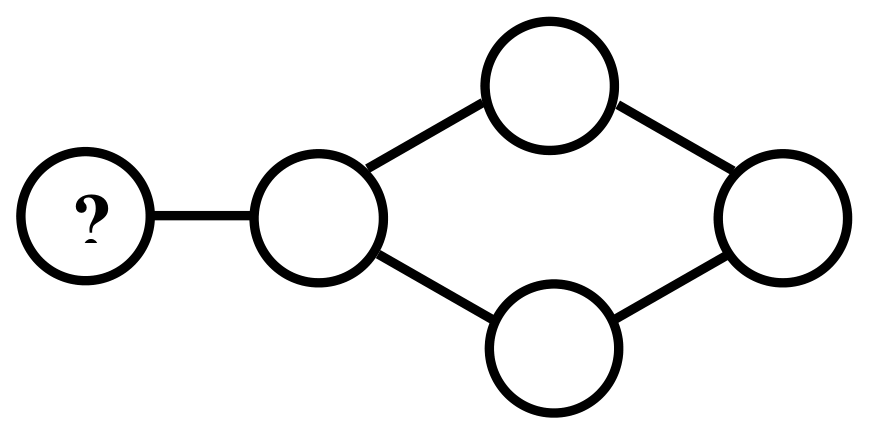
Numero al posto del punto interrogativo (consecutivi non connessi)
\begin{document}
\begin{tikzpicture}[every node/.style={draw, circle, minimum size=1cm, thick}]
  \node (Q) at (0,0) {?};
  \node (A) at (2,0) {};
  \node (B) at (4,1) {};
  \node (C) at (4,-1) {};
  \node (D) at (6,0) {};
  \draw[thick] (Q) -- (A);
  \draw[thick] (A) -- (B);
  \draw[thick] (A) -- (C);
  \draw[thick] (B) -- (D);
  \draw[thick] (C) -- (D);
\end{tikzpicture}
\end{document}
(Punti 4) Ciascuno dei numeri 1, 2, 3, 4, 5 va collocato in uno dei cerchi in figura (uno solo per cerchio) in modo che due numeri consecutivi non stiano mai in due cerchi connessi da un segmento. Quale numero va collocato al posto del punto di domanda? A) Solo 2. B) Solo 3. C) 2 oppure 4. D) 1 oppure 5. E) Solo 1. Risposta: B). Soluzione. Per verifica diretta sui 5 numeri. (bisogna che i vertici del rombo contengano coppie di numeri consecutivi disposti ai vertici opposti)
?
Topic: Logica, giochi, strategie, Combinatoria Metodo: Teoria dei grafi Abilita: Casework accurato Area: Combinatoria, Logica e Probabilita Risposta: B Fonte: apri PDF p.1
*Number at the place of the question mark (unrelated sequences) *
\begin{document}
\begin{tikzpicture}[every node/.style={draw, circle, minimum size=1cm, thick}]
  \node (Q) at (0,0) {?};
  \node (A) at (2,0) {};
  \node (B) at (4,1) {};
  \node (C) at (4,-1) {};
  \node (D) at (6,0) {};
  \draw[thick] (Q) -- (A);
  \draw[thick] (A) -- (B);
  \draw[thick] (A) -- (C);
  \draw[thick] (B) -- (D);
  \draw[thick] (C) -- (D);
\end{tikzpicture}
\end{document}
(Points 4) Each of the numbers 1, 2, 3, 4, 5 must be placed in one of the circles in the figure (one per circle only) so that two consecutive numbers are never in two circles connected by a segment. What number should be placed in place of the question mark? A) Only two. B) Only three. C) 2 or 4. D) 1 or 5. E) Only one. Answer: B). The solution. For direct verification on the five numbers. (the vertices of the rhombus must contain pairs of consecutive numbers arranged at opposite vertices)
?
Answer: B src_kangourou_2024_ecolier_semifinale__Q05
Fra quante fermate i passeggeri si dimezzano
(Punti 4) Su un treno della metropolitana ci sono 56 persone e mancano ancora molte fermate per arrivare al capolinea. Alla prossima fermata scenderà una persona in più di quante saliranno, alla successiva scenderanno due persone in più di quante saliranno, alla terza scenderanno tre persone in più di quante saliranno e così via. Fra quante fermate il treno ripartirà con un numero di passeggeri dimezzato rispetto al numero iniziale? A) 7 B) 8 C) 9 D) 10 E) 12 Risposta: A). Soluzione. Si dovranno perdere 56 : 2 = 28 passeggeri e ad ogni fermata se ne perderà uno in più rispetto alla fermata precedente: si ha 28 = 1 + 2 + … + 7.
Topic: Teoria dei Numeri Abilita: Riconoscimento di pattern Area: Aritmetica e Teoria dei Numeri Risposta: A Fonte: apri PDF p.2
The number of stops passengers make is halved
There are 56 people on a subway train, and many stops are still missing to the capital. At the next stop, one more person will come down than they climb, the next two more people will come down than they climb, the third three more people will come down than they climb, and so on. How many stops will the train leave with half the number of passengers from the start? A) 7 B) 8 C) 9 D) 10 E) 12 Answer: A). The solution. You will have to lose 56: 2 = 28 passengers and at each stop you will lose one more than at the previous stop: you have 28 = 1 + 2 + … + 7.
Answer: A src_kangourou_2024_ecolier_semifinale__Q06
Quale numero e certamente dispari
(Punti 5) Del numero N sai che è intero, ma non sai nient’altro. Quale dei seguenti numeri è certamente dispari? A) 17 × N B) N × N + 17 C) (N + 1) × N + 17 D) N × N × N E) N + 17 Risposta: C). Soluzione. Se N è pari, è pari anche D). Se N è dispari, sono pari A), B) e E). Qualunque sia N,
(N + 1) × N è pari perché o lo è N o lo è N + 1, dunque C) è dispari.
Topic: Teoria dei Numeri Metodo: Analisi per casi Abilita: generalizzazione Area: Aritmetica e Teoria dei Numeri Risposta: C Fonte: apri PDF p.2
What a number and certainly odd
You know that number N is an integer, but you know nothing else. Which of the following numbers is certainly odd? (A) 17 × N B) N × N + 17 C) (N + 1) × N + 17 D) N × N × N E) N + 17 Answer: C). The solution. If N is equal, it is also equal to D). If N is odd, they are equal to A, B, and E. Whatever N is, (N + 1) × N is equal because either it is N or it is N + 1, so C) is odd.
Answer: C src_kangourou_2024_ecolier_semifinale__Q07
In quale riga si trova 2024 (disposizione a moduli)
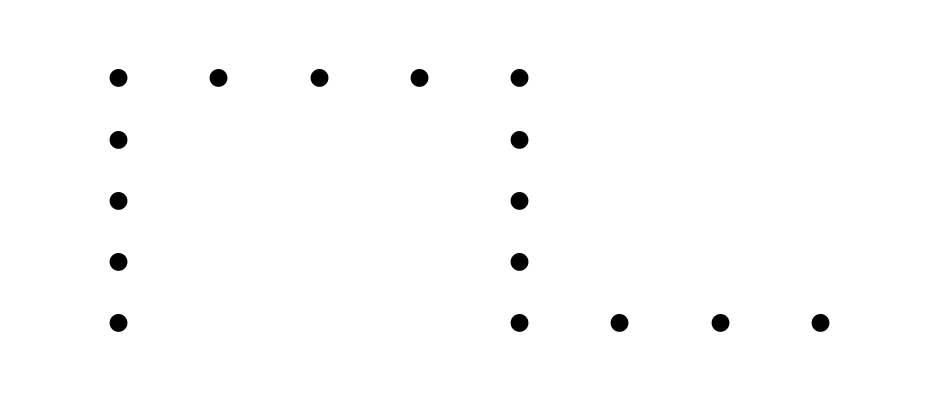
(Punti 5) Immagina di elencare tutti i numeri interi da 1 in poi disponendoli come indicato dalla figura, dove ogni “segmento verticale” e ogni “segmento orizzontale” di numeri consecutivi ne contiene esattamente 5. In quale riga, partendo dall’alto, si trova il numero 2.024? Riga 1 → 5 6 7 8 9
21 22 23 24 25
Riga 2 → 4
10
20
26
Riga 3 → 3
11
19
27
Riga 4 → 2
12
18
28
Riga 5 → 1
13 14 15 16 17
29 30 31 … A) La prima. B) La seconda. C) La terza. D) La quarta. E) La quinta. Risposta: A). Soluzione. La disposizione è costituita da un allineamento di moduli come quello in figura, ognuno dei quali ospita 16 interi consecutivi. Si ha 2.024 = 16 × 126 + 8: allora 2.024 si trova nella stessa riga del numero 8, dunque nella prima.
Topic: Teoria dei Numeri, Combinatoria Metodo: congruenze Abilita: Riconoscimento di pattern Area: Aritmetica e Teoria dei Numeri, Combinatoria, Logica e Probabilita Risposta: A Fonte: apri PDF p.2
*In which row is 2024 (module layout) *
(Points 5) Imagine listing all the integers from 1 onwards arranging them as shown in the figure, where each vertical segment and each horizontal segment of consecutive numbers contains exactly 5. In which line, starting from the top, is the number 2.024? This appropriation is intended to cover expenditure on technical assistance for the implementation of the programme.
21 22 23 24 25
The amount of the loan shall be calculated on the basis of the following:
10
20
26
The amount of the loan shall be calculated on the basis of the amount of the loan.
11
19
27
The amount of the loan shall be calculated on the basis of the amount of the loan.
12
18
28
The amount of the loan shall be calculated on the basis of the amount of the loan.
13 14 15 16 17
29 30 31 A) The first. B) The second. C) The third. D) The fourth. E) The fifth. Answer: A). The solution. The arrangement consists of an alignment of modules such as the one shown in the figure, each of which contains 16 consecutive integers. You have 2.024 = 16 × 126 + 8: then 2.024 is in the same line as the number 8, so in the first.
Answer: A src_kangourou_2024_ecolier_semifinale__Q08
Chi ha mentito tra i quattro nipotini
(Punti 6) La nonna prepara alcuni dolcetti; raccomanda ai suoi nipotini di aspettare a mangiarli e si allontana per pochi minuti. Un nipotino disobbedisce e mangia un dolcetto. La nonna ritorna, scopre che manca un dolcetto e chiede ai nipotini: “Chi è stato?” Angelo risponde: “Non sono stato io”.
Bruno risponde: “È stato Carlo”.
Donato risponde: “È stato Bruno”.
Carlo risponde: “Donato ha detto una bugia”.
Uno solo ha mentito. Chi? A) Angelo B) Bruno C) Carlo D) Donato E) Potrebbe aver mentito Bruno oppure Donato, ma non è possibile stabilirlo con certezza. Risposta: D) Sol. Se il disobbediente fosse stato Angelo, mentirebbero sia Bruno, sia Donato. Se fosse stato Bruno, oltre a lui mentirebbe anche Carlo. Se fosse stato Donato, oltre a lui mentirebbe Bruno. Allora è stato Carlo, ed è Donato che ha mentito.•
•
•
•
•
•
•
Quesiti a risposta aperta
Topic: Logica, giochi, strategie Metodo: Analisi per casi Abilita: Casework accurato Area: Combinatoria, Logica e Probabilita Risposta: D Fonte: apri PDF p.2
Who lied among the four grandchildren?
(Points 6) The grandmother prepares some candy; she advises her grandchildren to wait to eat it, and she goes away for a few minutes. A grandson disobeys and eats a candy. The grandmother returns, discovers that a dessert is missing, and asks the grandchildren, “Who was it?” Bruno replies: “It was Charles”. Donato answers: “It was Bruno”. Carlo replies, “Donato has lied”. Only one of them lied. Who’s that? A) Angelo B) Bruno C) Carlo D) Donato E) He may have lied to Bruno or Donato, but it is not possible to establish with certainty. Answer: D) Sun. If Angelo had been the disobedient one, Bruno and Donato would have lied. If it was Bruno, Carlo would lie to him. If it was Donato, besides him, Bruno would be lying. So it was Carlo, and it was Donato who lied. • • • • •
•
•
•
•
•
•
•
• • • •
Open-ended questions
Answer: D src_kangourou_2024_ecolier_semifinale__Q09
Massima somma di cifre di un orologio digitale
(Punti 4) Un orologio digitale mostra le ore con quattro cifre: ad esempio, se sono le 3 e 12 del pomeriggio mostra 15:12, e la somma delle cifre mostrate è 9. Nell’arco del giorno, qual è la più grande somma possibile delle cifre che l’orologio può mostrare, ad un dato istante? Risposta: 0024. Soluzione. Il massimo della somma delle cifre delle ore è 10, che si realizza con 19, quello della somma delle cifre dei minuti è 14 che si realizza con 59.
Topic: Teoria dei Numeri Abilita: Conteggio sistematico Area: Aritmetica e Teoria dei Numeri Risposta: 0024 Fonte: apri PDF p.3
Maximum number of digits of a digital watch
A digital clock displays the hours with four digits: for example, if it is 3 and 12 in the afternoon, it shows 15:12, and the sum of the digits shown is 9. In the course of a day, what is the largest possible sum of the figures that the clock can show at any given moment? The answer is 0024. The solution. The maximum of the sum of the hour numbers is 10, which is done with 19, the sum of the minute numbers is 14, which is done with 59.
Answer: 0024 src_kangourou_2024_ecolier_semifinale__Q10
Fra quanti anni la somma eta figli uguaglia eta padre
(Punti 4) Oggi, 25 maggio, Samuele compie 31 anni e i suoi tre figli compiono uno 2, uno 4 e uno 7 anni. Fra quanti anni, nella data del loro compleanno, la somma delle età dei figli di Samuele coinciderà con l’età del loro padre? Risposta: 0009. Soluzione. Per controllo diretto o graficamente oppure osservando che il doppio degli anni di attesa deve colmare la differenza fra 31 e 2 + 4 + 7 (l’età di Samuele aumenta di pari passo con l’età di ciascuno dei suoi figli).
Topic: Algebra, Teoria dei Numeri Abilita: Manipolazione algebrica Area: Algebra e Analisi, Aritmetica e Teoria dei Numeri Risposta: 0009 Fonte: apri PDF p.3
For how many years the sum of the children is equal to the father
Today, May 25, Samuel turns 31 and his three sons turn 2, 4, and 7. In how many years, on the date of their birthday, will the sum of the ages of Samuel’s sons coincide with the age of their father? The answer is: 0009. The solution. For direct or graphic control or by observing that the double of the waiting years must fill the difference between 31 and 2 + 4 + 7 (Samuel’s age increases with the age of each of his children).
Answer: 0009 src_kangourou_2024_ecolier_semifinale__Q11
Ultime quattro cifre del primo numero vivace > 598764
(Punti 6) Chiama “vivace” ogni numero che, come 598.764, può essere scritto usando sei cifre consecutive, anche se non elencate nel loro ordine naturale. Determina il primo numero vivace più grande di 598.764 e scrivi le sue ultime quattro cifre a destra. Risposta: 2345. Soluzione. È chiaro che il numero cercato non può iniziare per 5. Dovendo iniziare per 6, si ottiene subito 612.345.
Topic: Teoria dei Numeri Abilita: Riconoscimento di pattern Area: Aritmetica e Teoria dei Numeri Risposta: 2345 Fonte: apri PDF p.3
Last four digits of the first digit of the live number > 598764
(Points 6) Call vivace any number that, like 598.764, can be written using six consecutive digits, even if not listed in their natural order. Determine the first prime number greater than 598,764 and write its last four digits to the right. The answer is 2345. The solution. It’s clear that the number you’re looking for can’t start with 5. If you have to start with 6, you get 612,345.
Answer: 2345 src_kangourou_2024_ecolier_semifinale__Q12
Francobolli nella prima busta (ricorrenza a ritroso)
(Punti 6) Ci sono sei buste numerate allineate: dalla terza in poi, ognuna contiene tanti francobolli quanti ne contengono complessivamente le due immediatamente precedenti. La sesta contiene 71 francobolli, la quinta ne contiene 43. Quanti francobolli contiene la prima?
Risposta: 0002. Soluzione. Procedendo a ritroso, la quarta ne contiene 71 – 43 = 28, la terza 43 – 28 = 15, la seconda 28 – 15 = 13, la prima 15 – 13 = 2.
Topic: Teoria dei Numeri, successioni Metodo: Ragionamento all’indietro Abilita: Riconoscimento di pattern Area: Algebra e Analisi, Aritmetica e Teoria dei Numeri Risposta: 0002 Fonte: apri PDF p.3
*Francobolli in the first envelope (recurrence backwards) *
(Points 6) There are six numbered envelopes lined up: from the third to the next, each contains as many stamps as the two immediately preceding ones combined. The sixth contains 71 stamps, the fifth contains 43. How many stamps does the first one have? Answer: 0002. The solution. Proceeding backwards, the fourth contains 71 43 = 28, the third 43 28 = 15, the second 28 15 = 13, the first 15 13 = 2.
Answer: 0002 src_kangourou_2024_ecolier_semifinale__Q13
In quanti modi ripartire 1..8 in coppie con differenza costante
(Punti 8) Vuoi ripartire l’insieme dei numeri 1, 2, 3, 4, 5, 6, 7, 8 in quattro coppie di numeri tali che la differenza fra il maggiore e il minore dei numeri di ogni coppia sia sempre la stessa. In quanti diversi modi lo puoi fare? Risposta: 0003. Soluzione. Le differenze da prendere in esame sono solo 1, 2, 3 e 4: il numero 4 non ha differenza maggiore di 4 con alcuno degli altri. Ogni possibile differenza determina una e una sola ripartizione. Per 1 abbiamo le coppie {1, 2}, {3, 4}, {5, 6}, {7, 8}; per 2 abbiamo le coppie {1, 3}, {2, 4}, {5, 7}, {6, 8}; per 4 abbiamo le coppie {1, 5}, {2, 6}, {3, 7}, {4, 8}. Con 3 non è possibile procedere: sia 2 sia 8 dovrebbero essere in coppia con 5.
Topic: Combinatoria, Teoria dei Numeri Metodo: Conteggio combinatorio Abilita: Conteggio sistematico Area: Aritmetica e Teoria dei Numeri, Combinatoria, Logica e Probabilita Risposta: 0003 Fonte: apri PDF p.4
How many ways to divide 1.8 in pairs with constant difference
(Points 8) You want to divide the sum of the numbers 1, 2, 3, 4, 5, 6, 7, 8 into four pairs of numbers such that the difference between the major and minor numbers of each pair is always the same. How many different ways can you do that? The answer is: 0003. The solution. The differences to be considered are only 1, 2, 3 and 4: the number 4 has no difference greater than 4 with any of the others. Each possible difference determines one and only one distribution. For 1 we have the pairs {1, 2, 4, 5, 6, 8}; for 2 we have the pairs {1, 3, 4, 7, 8}; for 4 we have the pairs {1, 5, 6, 3, 7, 4, 8}. With 3 you can’t proceed: both 2 and 8 should be paired with 5.
Answer: 0003 src_kangourou_2024_ecolier_semifinale__Q14
Prodotto di 9 numeri 2 o 3 tra 600 e 1000
(Punti 8) Ho moltiplicato fra loro 9 numeri: ognuno di essi è 2 oppure 3. Il risultato di tale operazione è un numero compreso fra 600 e 1.000: qual è questo numero? Risposta: 0768. Soluzione. Si ha 29 = 512 < 600, dunque almeno uno dei fattori deve essere 3. D’altra parte, se almeno due fattori fossero 3, il prodotto sarebbe maggiore o uguale a 9 × 27 > 1.000. Allora 8 fattori sono 2 e uno solo è 3, con 768 come risultato dell’operazione.
Topic: Teoria dei Numeri Metodo: Analisi per casi Abilita: Manipolazione algebrica Area: Aritmetica e Teoria dei Numeri Risposta: 0768 Fonte: apri PDF p.4
Product of 9 numbers 2 or 3 between 600 and 1000
(Points 8) I’ve multiplied 9 numbers between them: each of them is 2 or 3. The result of this operation is a number between 600 and 1,000: what is this number? The answer is 0768. The solution. You have 29 = 512 < 600, so at least one of the factors must be 3. On the other hand, if at least two factors were 3, the product would be greater than or equal to 9 × 27 > 1000. So 8 factors is 2 and only one is 3, with 768 as the result of the operation.
Answer: 0768 src_kangourou_2024_ecolier_semifinale__Q15