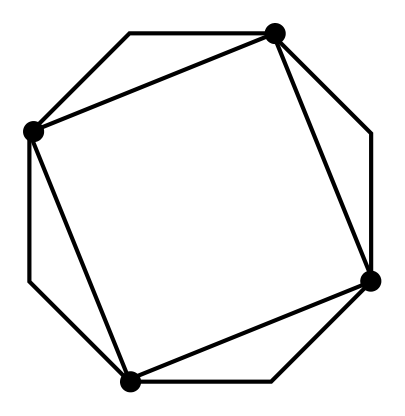
Area dell’ottagono regolare con quadrato inscritto di area 2
\begin{document}
\begin{tikzpicture}
  \coordinate (V0) at (0,2);
  \coordinate (V1) at (1.414,1.414);
  \coordinate (V2) at (2,0);
  \coordinate (V3) at (1.414,-1.414);
  \coordinate (V4) at (0,-2);
  \coordinate (V5) at (-1.414,-1.414);
  \coordinate (V6) at (-2,0);
  \coordinate (V7) at (-1.414,1.414);
  \draw (V0)--(V1)--(V2)--(V3)--(V4)--(V5)--(V6)--(V7)--cycle;
  \draw (V1)--(V3)--(V5)--(V7)--cycle;
  \filldraw (V1) circle (2.5pt);
  \filldraw (V3) circle (2.5pt);
  \filldraw (V5) circle (2.5pt);
  \filldraw (V7) circle (2.5pt);
\end{tikzpicture}
\end{document}
Ho mentito ieri e mentirò domani.
Topic: Geometria piana Abilita: Ragionamento geometrico Area: Geometria Risposta: C Fonte: apri PDF p.1
Area of the regular octagon with square inscribed area 2
\begin{document}
\begin{tikzpicture}
  \coordinate (V0) at (0,2);
  \coordinate (V1) at (1.414,1.414);
  \coordinate (V2) at (2,0);
  \coordinate (V3) at (1.414,-1.414);
  \coordinate (V4) at (0,-2);
  \coordinate (V5) at (-1.414,-1.414);
  \coordinate (V6) at (-2,0);
  \coordinate (V7) at (-1.414,1.414);
  \draw (V0)--(V1)--(V2)--(V3)--(V4)--(V5)--(V6)--(V7)--cycle;
  \draw (V1)--(V3)--(V5)--(V7)--cycle;
  \filldraw (V1) circle (2.5pt);
  \filldraw (V3) circle (2.5pt);
  \filldraw (V5) circle (2.5pt);
  \filldraw (V7) circle (2.5pt);
\end{tikzpicture}
\end{document}
I lied yesterday and I will lie tomorrow.
Answer: C src_kangourou_2024_student_semifinale__Q01
Ripartizione eredita inversamente proporzionale alle eta
Ieri era lunedì o martedì o mercoledì o giovedì.
Topic: Algebra Abilita: traduzione del testo Area: Algebra e Analisi Risposta: A Fonte: apri PDF p.1
*Heritage distribution inversely proportional to the ages *
Yesterday was Monday or Tuesday or Wednesday or Thursday.
Answer: A src_kangourou_2024_student_semifinale__Q02
Probabilita diamante nella scatola 9 dopo aperture
Domani sarà sabato o domenica o lunedì.
In che giorno è caduto il quindicesimo compleanno di Carlo? A) Certamente di lunedì.
B) Certamente di giovedì.
C) Certamente di venerdì.
D) Di giovedì o di venerdì, entrambi essendo possibili. E) Di lunedì o di venerdì, entrambi essendo possibili. Risposta: E). Soluzione. 1) può essere sia vera sia falsa. Se 1) è falsa devono essere false anche 2) e 3); se 2) è falsa il giorno può essere sabato, domenica o lunedì, se 3) è falsa il giorno può essere lunedì, martedì, mercoledì o giovedì: l’intersezione è lunedì. Se 1) è vera devono essere vere anche 2) e 3); se 2) è vera il giorno può essere martedì, mercoledì, giovedì o venerdì, se 3) è vera il giorno può essere venerdì, sabato o domenica: l’intersezione è venerdì.
Topic: Probabilita e statistica Abilita: traduzione del testo Area: Combinatoria, Logica e Probabilita Risposta: C o E Fonte: apri PDF p.1
Probability of diamonds in box 9 after opening
Tomorrow is Saturday or Sunday or Monday. On what day did Charles’ fifteenth birthday fall? A. Certainly on Monday. B) Certainly on Thursday. C) Certainly on Friday. D) Thursday or Friday, both being possible. E) Monday or Friday, both being possible. Answer: E). The solution. 1) can be either true or false. If 1) is false they must also be false 2) and 3); if 2) is false the day can be Saturday, Sunday or Monday; if 3) is false the day can be Monday, Tuesday, Wednesday or Thursday: the intersection is Monday. If 1) is true they must also be true 2) and 3); if 2) is true the day may be Tuesday, Wednesday, Thursday or Friday; if 3) is true the day may be Friday, Saturday or Sunday: the intersection is Friday.
Answer: C o E src_kangourou_2024_student_semifinale__Q03
Perche area di quadrato a vertici interi non puo essere 27
- (Punti 4) Nel piano cartesiano considera un quadrato Q i cui vertici hanno, ciascuno, entrambe le coordinate intere. Per quale dei seguenti motivi non può accadere che l’area di Q sia 27? A) Perché 27 è un intero dispari. B) Perché 27 non è la somma di due quadrati perfetti. C) Perché 27 è un cubo perfetto. D) Perché 27 non è un quadrato perfetto. E) Nessuno dei precedenti è un valido motivo.
Topic: Geometria analitica, Teoria dei Numeri Metodo: congruenze Abilita: generalizzazione Area: Aritmetica e Teoria dei Numeri, Geometria Risposta: B Fonte: apri PDF p.1
For the area of square with integer vertices cannot be 27
- In the Cartesian plane, consider a square Q whose vertices have, each, both integers. For which of the following reasons cannot the area of Q be 27? A) Because 27 is a whole odd. B) Because 27 is not the sum of two perfect squares. C) Because 27 is a perfect cube. D) Because 27 is not a perfect square. E) None of the above is a valid reason.
Answer: B src_kangourou_2024_student_semifinale__Q04
Giorno del compleanno con affermazioni vero/menzogna
- (Punti 4) A giorni alterni, Carlo dice la verità o mente per l’intera giornata. Nel giorno del suo quindicesimo compleanno, Carlo ha fatto le tre affermazioni riportate qui di seguito.
Topic: Logica, giochi, strategie Metodo: Analisi per casi Abilita: Casework accurato Area: Combinatoria, Logica e Probabilita Risposta: E Fonte: apri PDF p.2
Birthday with true/false statements
- On alternate days, Charles tells the truth or lies for the whole day. On the day of his fifteenth birthday, Charles made the three statements listed below.
Answer: E src_kangourou_2024_student_semifinale__Q05
Probabilita prodotto di tre numeri termini con piu zeri
(Punti 4) Moltiplicando tra loro tre numeri scelti a caso nell’insieme {38, 55, 68, 104, 175, 375}, quante probabilità si hanno su 100 che il prodotto termini con il massimo numero di zeri possibile?
A) 10 B) 15 C) 20 D) 25 E) 30 Risposta: E). Soluzione. Le fattorizzazioni dei sei numeri sono, nell’ordine, 2 × 19, 5 × 11, 22 × 17, 23 × 13, 52 × 7, 53 × 3. Il numero di zeri è dato dal più alto esponente al quale nel prodotto può comparire elevato
2 × 5; questo esponente è chiaramente 3, ottenibile con le seguenti diverse scelte della terna: {104, 375, uno qualunque dei 4 rimanenti}, {38, 68, 375}, {55, 104, 175}, per un totale di 6 terne su 20.
Topic: Probabilita e statistica, Teoria dei Numeri Metodo: congruenze, Conteggio combinatorio Abilita: Conteggio sistematico Area: Aritmetica e Teoria dei Numeri, Combinatoria, Logica e Probabilita Risposta: E Fonte: apri PDF p.2
*Probability of three-digit product terms with more than zero *
(Points 4) Multiplying between them three randomly chosen numbers in the {38, 55, 68, 104, 175, 375}, what is the probability out of 100 that the product ends with the maximum number of zeros possible? A) 10 B) 15 C) 20 D) 25 E) 30 Answer: E). The solution. The factors of the six numbers are, in the order, 2 × 19, 5 × 11, 22 × 17, 23 × 13, 52 × 7, 53 × 3. The number of zeros is given by the highest exponent to which a high 2 × 5 can appear in the product; this exponent is clearly 3, which can be obtained by the following different choices of the trane: {104, 375, any of the remaining 4}, {38, 68, 375}, {55, 104, 175}, for a total of 6 out of 20 trane.
Answer: E src_kangourou_2024_student_semifinale__Q06
Minimo n studenti per coprire tutti gli otto problemi
(Punti 5) Otto studenti hanno affrontato la stessa prova individuale composta da otto problemi. Ogni problema è stato risolto correttamente da almeno cinque studenti. Qual è il più piccolo valore di n per il quale risulta vero quanto segue: ci sono n studenti tali che ogni problema è stato risolto da almeno uno di essi?
A) 2 B) 3 C) 4 D) 5 E) 6 Risposta: A). Soluzione. Sia N il più grande numero di problemi risolti da un singolo studente. È chiaro che, se N < 8, n deve essere almeno 2 e che n = 2 è sufficiente se N = 7. Se N = 6, ognuno dei rimanenti due problemi deve essere stato risolto da 5 studenti, dunque almeno uno di questi 5 deve averli risolti entrambi: ancora n = 2 è sufficiente. Se N = 5 ogni problema è stato risolto da esattamente 5 studenti (le risposte corrette devono essere almeno 40); consideriamo i tre problemi non risolti da uno studente qualsiasi: complessivamente devono ammettere 15 soluzioni, dunque deve esserci qualcuno dei rimanenti 7 studenti che li ha risolti tutti e tre. È chiaro che non può essere N < 5.In realtà mi pare che, nell’ultimo caso, ci sia una perfetta simmetria che porta ad avere 3 studenti che hanno risolto i problemi non risolti dallo studente preso in esame
Topic: Combinatoria, Logica, giochi, strategie Metodo: Principio di estremalita Abilita: Casework accurato Area: Combinatoria, Logica e Probabilita Risposta: A Fonte: apri PDF p.2
Minimum number of students to cover all eight problems
Eight students faced the same individual test consisting of eight problems. Each problem was solved correctly by at least five students. What is the smallest value of n for which the following is true: there are n students such that each problem has been solved by at least one of them? A) 2 B) 3 C) 4 D) 5 E) 6 Answer: A). The solution. So N is the largest number of problems solved by a single student. It is clear that if N < 8, n must be at least 2 and that n = 2 is sufficient if N = 7. If N = 6, each of the remaining two problems must have been solved by 5 students, so at least one of these 5 must have solved both: still n = 2 is enough. If N = 5 each problem was solved by exactly 5 students (the correct answers must be at least 40); let’s consider the three problems not solved by any student: in total they have to admit 15 solutions, so there must be one of the remaining 7 students who solved all three. It’s clear that it can’t be N < 5.
In fact, it seems to me that in the latter case, there is a perfect symmetry that leads to having three students solve the problems that the student in question did not solve.
Answer: A src_kangourou_2024_student_semifinale__Q07
Quante strisce ottenibili cambiando colore a 4 quadrati

(Punti 5) Una striscia è formata da 8 quadrati allineati ciascuno dei quali può essere bianco o grigio. Una mossa consiste nel cambiare il colore da bianco a grigio o viceversa di ciascuno di quattro quadrati consecutivi. Se si parte da una striscia in cui i quadrati sono tutti bianchi, quante delle quattro strisce seguenti possono essere ottenute dopo un numero opportuno di mosse, anche variabile da striscia a striscia?
A) 0 (nessuna) B) 1 C) 2
D) 3 E) 4 (tutte) Risposta A).
Topic: Combinatoria Metodo: monovarianti Abilita: Riconoscimento di pattern Area: Combinatoria, Logica e Probabilita Risposta: A Fonte: apri PDF p.3
How many strips can be obtained by changing colour in 4 squares
(Points 5) A strip consists of eight aligned squares, each of which may be white or gray. One move consists of changing the color from white to gray or vice versa for each of four consecutive squares. If you start from a strip where the squares are all white, how many of the following four strips can be obtained after an appropriate number of moves, even variable from strip to strip? A) 0 (no) B) 1 C) 2 D) 3 E) 4 (all) Answer A).
Answer: A src_kangourou_2024_student_semifinale__Q08
Massimo numero di telecamere ridondanti su strada 1000m
(Punti 6) Una strada rettilinea lunga 1.000 metri viene controllata mediante n telecamere ognuna delle quali copre esattamente un tratto lungo 10 metri alla sua sinistra e 10 metri alla sua destra, estremi inclusi, ma non copre alcun punto fuori dalla strada. Le telecamere sono più del necessario ma sono disposte in modo tale che, se anche una sola di esse non funzionasse, rimarrebbe scoperto qualche tratto di strada. Qual è il massimo valore possibile per n? A) 49 B) 50 C) 51 D) 74 E) 98 Risposta: E). Soluzione. Numeriamo le telecamere in modo progressivo lungo la strada partendo da 1. Se il tratto coperto dalla k-esima intersecasse quello coperto dalla (k+2)-esima, la (k+1)-esima sarebbe inutile: allora i tratti coperti da telecamere con numeri dispari sono disgiunti, dunque non possono essere più di 49. Deve essere n < 99 poiché, in caso contrario, ci sarebbero almeno 50 “tratti dispari”. Può essere n = 98. È sufficiente distribuire le 98 telecamere in modo che siano uniformemente distanziate con la prima e l’ultima a 10 metri dall’estremo di strada corrispondente: la distanza tra la k-esima e la (k+2)-esima telecamera è allora di 2 × 980 / 97 metri che, essendo superiore a 20 metri, non può che essere coperta dalla (k+1)-esima telecamera (analogo ragionamento agli estremi).
Quesiti a risposta aperta
Topic: Combinatoria Metodo: Principio di estremalita Abilita: Casework accurato Area: Combinatoria, Logica e Probabilita Risposta: E Fonte: apri PDF p.3
Maximum number of redundant cameras on the road 1000m
(Points 6) A 1,000-meter straight road is monitored by n cameras, each covering exactly 10 meters to its left and 10 meters to its right, extremes included, but not covering any point off the road. The cameras are more than necessary, but they are arranged in such a way that even if one of them does not work, some stretches of the road will be discovered. What’s the maximum possible value for n? A) 49 B) 50 C) 51 D) 74 E) 98 Answer: E). The solution. Let’s count the cameras gradually along the way starting with 1. If the section covered by the k-exima intersects the section covered by the (k+2)-exima, the (k+1)-exima would be useless: then the sections covered by cameras with odd numbers are disjoint, so they cannot be more than 49. It must be n < 99 because otherwise there would be at least 50 odd tracts. It can be n = 98. It is sufficient to distribute the 98 cameras so that they are evenly spaced with the first and last at 10 meters from the end of the corresponding street: the distance between the k-eighth and the (k+2)-eighth camera is then 2 × 980 / 97 meters which, being greater than 20 meters, can only be covered by the (k+1)-eighth camera (analog reasoning to the ends).
Open-ended questions
Answer: E src_kangourou_2024_student_semifinale__Q09
Valore di (cd-ab)(c+d) con somma e somma inversi nulle
(Punti 4) Quattro numeri reali a, b, c, d tutti diversi da 0 sono tali che la loro somma è 0, come pure la somma dei loro inversi con l’inverso del loro prodotto. Quanto vale (cd – ab)(c + d)? Risposta: 0001. Soluzione. Dalla seconda condizione si ottiene cd(a + b) + ab(c + d) = – 1. Dalla prima, essendo a + b = – (c + d), si ottiene allora che il numero cercato è 1.
Topic: Algebra Metodo: manipolazione algebrica Abilita: Manipolazione algebrica Area: Algebra e Analisi Risposta: 1 Fonte: apri PDF p.3
Value of (cd-ab)(c+d) with sum and inverse sum of zero
(Points 4) Four real numbers a, b, c, d all other than 0 are such that their sum is 0, as well as the sum of their inverse with the inverse of their product. How much is (cd ab) c + d)? The answer is: 0001. The solution. From the second condition we get cd(a + b) + ab(c + d) = 1. From the first, being a + b = (c + d), you get then that the number you’re looking for is 1.
Answer: 1 src_kangourou_2024_student_semifinale__Q10
Quanti interi tra 0 e 10 esprimibili con quattro 4
(Punti 5) Voglio esprimere il maggior numero possibile di interi utilizzando solo la cifra 4 ed esattamente quattro volte. Posso accostare più volte la cifra 4, utilizzare le quattro operazioni aritmetiche e disporre parentesi nei modi che ritengo opportuni. Ad esempio posso scrivere 0 = 4 – A B C D E F G H a a + b a + b + c a+b+c+d b+c+d+e c + d + e d + e e 4 + 4 – 4, oppure 15 = 44/4 + 4, oppure 160 = (44 – 4) × 4. Quanti dei numeri interi tra 0 e 10 compresi posso esprimere con questa procedura?
Risposta: 0011. Soluzione. 0 = 4 – 4 + 4 – 4; 1 = 44/44; 2 = 4/4 + 4/4; 3 = (4 + 4 + 4)/4; 4 = 4 – (4 – 4)/4;
5 = (4 × 4 + 4)/4; 6 = (4 + 4)/4 + 4; 7 = 44/4 – 4; 8 = 4 + 4 + 4 – 4; 9 = 4 + 4 + 4/4; 10 = (44 – 4)/4.
Topic: Teoria dei Numeri, Combinatoria Abilita: Conteggio sistematico Area: Aritmetica e Teoria dei Numeri, Combinatoria, Logica e Probabilita Risposta: 11 Fonte: apri PDF p.3
*Entire numbers between 0 and 10 expressed as four *
(Points 5) I want to express as many integers as possible using just the number 4 and exactly four times. I can approach the number 4 several times, use the four arithmetic operations, and arrange brackets in the ways that I think are appropriate. For example, I can write 0 = 4 A B C D E F G H a + b a + b + c a + b + c + d b + c + d + e c + d + e
4 + 4 4, or 15 = 44/4 + 4, or 160 = (44 4) × 4. How many of the integers between 0 and 10 can I express with this procedure? The answer is 0011. The solution. 0 = 4 – 4 + 4 – 4; 1 = 44/44; 2 = 4/4 + 4/4; 3 = (4 + 4 + 4)/4; 4 = 4 – (4 – 4)/4; 5 = (4 × 4 + 4)/4; 6 = (4 + 4)/4 + 4; 7 = 44/4 – 4; 8 = 4 + 4 + 4 – 4; 9 = 4 + 4 + 4/4; 10 = (44 – 4)/4.
Answer: 11 src_kangourou_2024_student_semifinale__Q11
Massimo angoli < 170 gradi in poligono convesso
(Punti 5) Quanti angoli che misurino meno di 170 gradi può avere al massimo un poligono convesso?
Risposta: 0035. Soluzione. La somma dei complementi a 180 delle misure in gradi degli angoli di un poligono convesso deve essere 360. D’altra parte, avvalendosi di questa considerazione, è chiaro che esiste un poligono di 36 lati con 35 angoli che misurino meno di 170 gradi.
Topic: Geometria piana Metodo: Principio di estremalita Abilita: Ragionamento geometrico Area: Geometria Risposta: 35 Fonte: apri PDF p.4
Maximum angles < 170 degrees in the convex polygon
(Points 5) How many angles less than 170 degrees can a convex polygon have? The answer is 0035. The solution. The sum of the additions to 180 of the measurements in degrees of angles of a convex polygon shall be 360. On the other hand, on the basis of this consideration, it is clear that there is a polygon of 36 sides with 35 angles measuring less than 170 degrees.
Answer: 35 src_kangourou_2024_student_semifinale__Q12
Minimo n con Sn+S(n-1)>2024 diagonali poligono
(Punti 6) Assegnato un poligono convesso di n lati (n > 3), indichiamo con Sn il numero delle sue diagonali. Qual è il più piccolo valore di n tale che Sn + Sn – 1 > 2024? Risposta: 0048. Soluzione. Per ogni n > 3 si ha Sn = n(n – 3)/2, da cui Sn + Sn – 1 = n2 – 4n + 2. Affinché si abbia n2 – 4n – 2022 > 0 deve essere n > 2 + √2026. Il primo quadrato perfetto maggiore di 2026 è 2116 = 462.
Topic: Combinatoria, Algebra Metodo: manipolazione algebrica Abilita: Manipolazione algebrica Area: Algebra e Analisi, Combinatoria, Logica e Probabilita Risposta: 48 Fonte: apri PDF p.4
Minimum n with Sn+S(n-1)>2024 diagonal polygon
(Points 6) Assigned to a polygon convex of n sides (n > 3), we use Sn to indicate the number of its diagonal. What is the smallest value of n such that Sn + Sn 1 > 2024? The answer is 0048. The solution. For every n > 3 we have Sn = n(n 3)/2, where Sn + Sn 1 = n2 4n + 2. In order to have n2 4n 2022 > 0 must be n > 2 + √2026. The first perfect square greater than 2026 is 2116 = 462.
Answer: 48 src_kangourou_2024_student_semifinale__Q13
Minimo n problemi con corrette/sbagliate distinte per 50
(Punti 6) A una gara matematica sono stati proposti n problemi a 50 concorrenti. Per ogni singolo concorrente, sono state contate le risposte corrette fornite, quelle sbagliate e quelle non date. Non vi sono stati due concorrenti che abbiano fornito sia lo stesso numero di risposte corrette, sia lo stesso numero di risposte sbagliate. Qual è il più piccolo valore possibile per n? Risposta: 0009. Soluzione. Nelle nostre ipotesi, per 0 ≤ k ≤ n, gli elaborati ammissibili con esattamente k risposte corrette sono in numero di n – k + 1 (potrebbero non esserci risposte non date). La somma di tutti questi numeri al variare di k è la somma degli interi da 1 a n + 1 inclusi, cioè e questo valore deve essere almeno 50. Da , con n intero, segue .
Topic: Combinatoria Metodo: Principio dei cassetti Abilita: Conteggio sistematico Area: Combinatoria, Logica e Probabilita Risposta: 9 Fonte: apri PDF p.4
Minimum problems with distinct corrections/errors for 50
(Points 6) A mathematical contest was presented with problems for 50 contestants. For each individual contestant, the correct answers given, the wrong ones and the ones not given were counted. There were no two competitors who provided both the same number of correct answers and the same number of incorrect answers. What’s the smallest possible value for n? The answer is: 0009. The solution. In our assumptions, for 0 ≤ k ≤ n, the eligible data with exactly k correct answers are in the number of n k + 1 (there may not be any unspecified answers). The sum of all these numbers in k is the sum of the integers from 1 to n + 1 included, i.e. and this value must be at least 50. From , with n integers, follows .
Answer: 9 src_kangourou_2024_student_semifinale__Q14
Minimo n con area AnBnC < 10 in triangolo rettangolo
\begin{document}
\begin{tikzpicture}
  \coordinate (A) at (0,0);
  \coordinate (B) at (0,2);
  \coordinate (C) at (3.464,0);
  \coordinate (A1) at (1.1547,0);
  \coordinate (B1) at (1.732,1);
  \draw[thick] (A)--(B)--(C)--cycle;
  \draw (B)--(A1);
  \draw (A1)--(B1);
  \node[left] at (B) {$B$};
  \node[below left] at (A) {$A$};
  \node[right] at (C) {$C$};
  \node[below] at (A1) {$A_1$};
  \node[above right] at (B1) {$B_1$};
\end{tikzpicture}
\end{document}
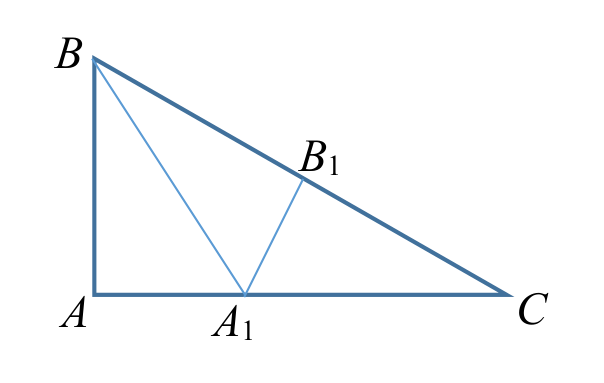
(Punti 6) È dato un triangolo ABC, rettangolo in A e il cui angolo in B misura 60 gradi; tale triangolo ha area 2024. Con la procedura che segue vengono individuate due sequenze di punti: A1, A2, A3, … sul lato AC e B1, B2, B3, … sul lato BC:
• A1 è sulla bisettrice dell’angolo ABC, il segmento A1B1 è perpendicolare al lato BC;
• B2 è sulla bisettrice dell’angolo B1A1C, il segmento B2A2 è perpendicolare al lato AC;
• A3 è sulla bisettrice dell’angolo A2B2C, il segmento A3B3 è perpendicolare al lato BC
e così via. Qual è il più piccolo intero n tale che l’area del triangolo AnBnC sia minore di 10? Risposta: 0005. Soluzione. I triangoli ABA1, A1BB1 e A1B1C sono congruenti: quindi l’area di A1B1C è 1/3 di quella di ABC. Dato che tutti i triangoli AhBhC sono simili ad ABC, la situazione si ripropone per ogni triangolo AhBhC rispetto ad Ah-1Bh-1C e per n = 5 l’area 2024/35 = 2024/243 di AnBnC diventa per la prima volta minore di 10.
Topic: Geometria piana Metodo: Ricorsione Abilita: Ragionamento geometrico Area: Geometria Risposta: 5 Fonte: apri PDF p.4
Minimum n with AnBnC area < 10 in a rectangular triangle
\begin{document}
\begin{tikzpicture}
  \coordinate (A) at (0,0);
  \coordinate (B) at (0,2);
  \coordinate (C) at (3.464,0);
  \coordinate (A1) at (1.1547,0);
  \coordinate (B1) at (1.732,1);
  \draw[thick] (A)--(B)--(C)--cycle;
  \draw (B)--(A1);
  \draw (A1)--(B1);
  \node[left] at (B) {$B$};
  \node[below left] at (A) {$A$};
  \node[right] at (C) {$C$};
  \node[below] at (A1) {$A_1$};
  \node[above right] at (B1) {$B_1$};
\end{tikzpicture}
\end{document}
(Points 6) A triangle ABC, rectangular in A and whose angle in B measures 60 degrees is given; that triangle has area 2024. With the following procedure two sequences of points are identified: A1, A2, A3, … on the AC side and B1, B2, B3, … on the BC side: • A1 is on the ABC angle beam, segment A1B1 is perpendicular to the BC side; • B2 is on the B1A1C angle beam, segment B2A2 is perpendicular to the AC side; • A3 is on the A2B2C angle beam, segment A3B3 is perpendicular to the BC side and so on. What is the smallest integer n such that the area of the AnBnC triangle is less than 10? The answer is: 0005. The solution. The triangles ABA1, A1BB1 and A1B1C are congruent, so the area of A1B1C is 1/3 of that of ABC. Since all AhBhC triangles are similar to ABC, the situation is repeated for each AhBhC triangle with respect to Ah-1Bh-1C and for n = 5 larea 2024/35 = 2024/243 of AnBnC becomes for the first time less than 10.
Answer: 5 src_kangourou_2024_student_semifinale__Q15
Interi di due cifre con quoziente 7 per somma cifre
(Punti 7) Quanti sono i numeri interi positivi di due cifre che, divisi per la somma delle loro cifre, danno come quoziente 7 (ed eventualmente un resto)? Risposta: 0011. Soluzione. Detti 10A + B i numeri in questione, deve essere
(10A + B) / (A + B) = 7 + r / (A + B) con 0 ≤ r < A + B ≤ 18. Chiaramente ciò esclude che sia B = 0. Da 10A + B = 7A + 7B + r segue subito che r = 3(A – 2B) deve essere divisibile per 3: le possibilità (per ora teoriche) per r sono dunque 0, 3, 6, 9, 12, 15. Passiamole in rassegna, ricordando che deve essere r < A + B = 3B + r/3 cioè 2r < 9B: r = 0 comporta A = 2B, dunque porta agli interi 84, 63, 42, 21;
A B C A1 B1r = 3 comporta A = 1 + 2B, dunque porta agli interi 94, 73, 52, 31;
r = 6 comporta A = 2 + 2B, dunque porta agli interi 83, 62
r = 9 comporta A = 3 + 2B, dunque porta all’intero 93 r = 12 e r = 15 non lasciano possibilità.
Topic: Teoria dei Numeri Metodo: Analisi per casi Abilita: Casework accurato Area: Aritmetica e Teoria dei Numeri Risposta: 11 Fonte: apri PDF p.4
Two-digit integers with a coefficient of 7 per digit sum
(Points 7) What are the positive integers of two digits that, divided by the sum of their digits, give as a quotient 7 (and possibly a residual)? The answer is 0011. The solution. If the numbers in question are 10A + B, it must be (10A + B) / (A + B) = 7 + r / (A + B) with 0 ≤ r < A + B ≤ 18. Clearly this excludes that B is equal to 0. From 10A + B = 7A + 7B + r it follows immediately that r = 3(A 2B) must be divisible by 3: the possibilities (for now theoretical) for r are therefore 0, 3, 6, 9, 12, 15. Let’s go through them, remembering that it has to be r < A + B = 3B + r/3 i.e. 2r < 9B: r = 0 involves A = 2B, so it leads to the integers 84, 63, 42, 21; A B C A1 B1
r = 3 involves A = 1 + 2B, so it leads to the integers 94, 73, 52, 31; r = 6 involves A = 2 + 2B, so it leads to the integers 83, 62 r = 9 involves A = 3 + 2B, so it leads to the whole 93 r = 12 and r = 15 do not leave any possibility.
Answer: 11 src_kangourou_2024_student_semifinale__Q16
Massimo interi consecutivi la cui somma di cubi e 2024
(Punti 7) Sommando i cubi di alcuni numeri interi consecutivi si ottiene come risultato 2024. Quanti possono essere al massimo questi interi? Risposta: 0011. Soluzione. Un noto teorema afferma che, per ogni intero positivo n, la somma dei cubi dei primi n interi positivi coincide con il quadrato della somma di questi primi n interi. La somma dei primi n interi positivi vale n(n + 1)/2: velocemente si trova allora che 452 = 2025 è la somma dei cubi degli interi da 1 a 9. Dunque 2024 è la somma dei cubi degli interi da 2 a 9, ma anche dei cubi degli interi da -1 a 9. È facile appurare che questa sequenza di interi consecutivi non può essere estesa.
Topic: Teoria dei Numeri Metodo: manipolazione algebrica Abilita: Manipolazione algebrica Area: Aritmetica e Teoria dei Numeri Risposta: 11 Fonte: apri PDF p.4
Maximum consecutive integers whose cube sum and 2024
(Points 7) Adding the cubes of some consecutive integers gives us a result of 2024. How many of these integers can be at most? The answer is 0011. The solution. A well-known theorem states that for every positive integer n, the sum of the cubes of the first positive integers coincides with the square of the sum of these first n integers. The sum of the first n positive integers is n n + 1)/2: quickly finds then that 452 = 2025 is the sum of the cubes of the integers from 1 to 9. So 2024 is the sum of the cubes of integers 2 through 9, but also the cubes of integers 1 through 9. It is easy to see that this sequence of consecutive integers cannot be extended.
Answer: 11 src_kangourou_2024_student_semifinale__Q17
1/p prob biglie rosse e verdi sempre diverse
(Punti 8) In una scatola vi sono 1.016 biglie rosse e 1.008 biglie verdi. Calcola la probabilità p che, estraendo a caso una biglia alla volta, dopo ogni estrazione il numero delle biglie rosse rimaste nella scatola rimanga sempre diverso dal numero delle biglie verdi rimaste nella scatola? Scrivi il numero 1/p o, se non fosse intero, il numero intero ad esso più vicino.
Risposta: 0253. Soluzione. Calcoliamo la probabilità dell’evento complementare C, cioè che, dopo qualche estrazione, le biglie verdi rimaste nella scatola siano tante quante le rosse. Immaginiamo di compiere l’operazione inversa, cioè di riempire la scatola attingendo alle biglie da fuori, cosa che è equivalente ai nostri fini. Se la prima biglia inserita è verde, il che accade con probabilità 1.008/2.024, certamente C si verifica. Supponiamo ora che la prima biglia inserita sia rossa e che ancora C si verifichi. Consideriamo la prima volta in cui C si verifica: l’ultimo inserimento deve essere stato di una biglia verde. Poiché abbiamo solo biglie rosse o verdi, la probabilità a priori che quell’inserimento sia stato di una biglia verde è ancora 1.008/2.024. Dunque si ha p = 1 – 2 × 1.008/2.024 = 8/2.024 = 1/253.
Topic: Probabilita e statistica, Combinatoria Metodo: Conteggio combinatorio Abilita: traduzione del testo Area: Combinatoria, Logica e Probabilita Risposta: 253 Fonte: apri PDF p.5
1/p prob red and green bags always different
In a box there are 1,016 red and 1,008 green bubbles. Do you calculate the probability that, if you randomly extract one seed at a time, after each extraction, the number of red seed remaining in the box will always remain different from the number of green seed remaining in the box? Write the number 1/p or, if it is not an integer, the integer nearest it. The answer is 0253. The solution. Let’s calculate the probability of the complementary event C, that is, after some extraction, the green balls left in the box are as many as the red ones. Let’s imagine doing the reverse operation, which is filling the box by drawing the seeds from the outside, which is equivalent to our purpose. If the first card entered is green, which happens with probability of 1.008/2.024, C is certainly occurring. Now let’s say that the first card you put in is red and that C happens again. Consider the first time C occurs: the last insert must have been a green leaf. Since we only have red or green balls, the probability a priori that this was a green ball is still 1,008/2,024. So you have p = 1 2 × 1.008/2.024 = 8/2.024 = 1/253.
Answer: 253 src_kangourou_2024_student_semifinale__Q18