Rectangle 48 × 15 divided into 6 rectangles of equal area; perimeter of the highlighted one.
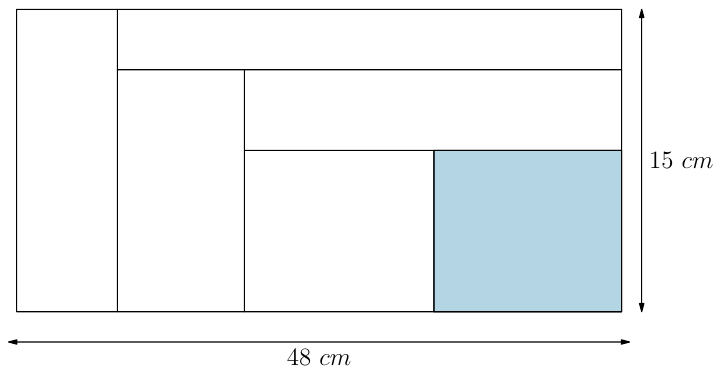
The rectangle below has been divided into 6 rectangles of the same area. What is the perimeter of the highlighted rectangle, in cm? (The large rectangle measures .)
Topic: Geometria piana Area: Geometria Risposta: nessuna soluzione ufficiale pubblicata (problema dimostrativo / a risposta aperta). Fonte risposta: OBM, «Provas e gabaritos» — per la prova 2026 è pubblicato solo il testo (pagina OBM). Fonte: apri PDF p.1
Rettangolo 48 × 15 diviso in 6 rettangoli di uguale area: perimetro di quello evidenziato.
Il rettangolo qui sotto è stato diviso in 6 rettangoli della stessa area. Qual è il perimetro, in cm, del rettangolo evidenziato? (Il rettangolo grande misura .)
“Impressive” numbers: digit sum of 2026·n equals n; smallest and largest.
A positive integer is called impressive when the sum of the digits of the product equals . For example, 26 is impressive, since and the sum of the digits of this result is .
(a) What is the smallest impressive positive integer?
(b) Now let us look for the largest impressive number . With some computation one can prove that is at most 54; you do not need to prove this here. Note that . What is the largest possible digit sum of a number less than or equal to 109404?
(c) What is the largest impressive positive integer?
Topic: Teoria dei Numeri Area: Aritmetica e Teoria dei Numeri Risposta: nessuna soluzione ufficiale pubblicata (problema dimostrativo / a risposta aperta). Fonte risposta: OBM, «Provas e gabaritos» — per la prova 2026 è pubblicato solo il testo (pagina OBM). Fonte: apri PDF p.1
Numeri «impressionanti»: la somma delle cifre di 2026·n è n; il minimo e il massimo.
Un intero positivo si dice impressionante se la somma delle cifre del prodotto è uguale a . Per esempio, 26 è impressionante, perché e la somma delle cifre di questo risultato è .
(a) Qual è il più piccolo intero positivo impressionante?
(b) Cerchiamo ora il più grande numero impressionante . Con qualche calcolo si può dimostrare che è al massimo 54: in questa prova non è richiesto dimostrarlo. Si osservi che . Qual è la massima somma delle cifre di un numero minore o uguale a 109404?
(c) Qual è il più grande intero positivo impressionante?
Round-robin football tournament of 2026 teams, all with equal points P; decisive games and range of P.
In a football championship with 2026 teams, each team plays exactly once against each of the others. In each match the winner gets 3 points and the loser gets no points; in case of a draw, each of the two teams gets 1 point. At the end of the championship, all teams finished with the same score .
(a) Show that the number of matches that ended with a winner is a multiple of 2026.
(b) Determine the minimum and maximum values of . Remember to justify these values and to show how the results of the matches could be for these values to be attained.
Topic: Combinatoria, Teoria dei Numeri Area: Combinatoria, Logica e Probabilita, Aritmetica e Teoria dei Numeri Risposta: nessuna soluzione ufficiale pubblicata (problema dimostrativo / a risposta aperta). Fonte risposta: OBM, «Provas e gabaritos» — per la prova 2026 è pubblicato solo il testo (pagina OBM). Fonte: apri PDF p.1
Torneo di calcio all’italiana con 2026 squadre, tutte con lo stesso punteggio P: partite con un vincitore e valori di P.
In un campionato di calcio con 2026 squadre, ogni squadra gioca esattamente una volta contro ciascuna delle altre. In ogni partita chi vince ottiene 3 punti e chi perde 0 punti; in caso di pareggio, ciascuna delle due squadre ottiene 1 punto. Alla fine del campionato tutte le squadre hanno lo stesso punteggio .
(a) Dimostrare che il numero di partite terminate con un vincitore è un multiplo di 2026.
(b) Determinare i valori minimo e massimo di . Ricordarsi di giustificare tali valori e di mostrare come potrebbero essere i risultati delle partite perché questi valori vengano raggiunti.
One-player 2048-style game on a 3 × 3 board; minimum and maximum final sum.

In this problem we study a one-player game. The game uses a board, initially empty, and each turn consists of two or three steps, except the last turn, which has only one step. Before the last turn, the first two steps always happen and the third depends on the numbers on the board. The steps are:
Insertion: the player chooses an empty cell of the board and places in it a tile of value 2.
Sliding: the player chooses a direction (). All tiles slide simultaneously, as far as possible, in that direction.
Merging: during the sliding, if two tiles with the same number collide, they merge into a single tile whose value is the sum of both (merging has priority at the destination edge). A tile resulting from a merge cannot merge again in the same turn in which it was created.
If the insertion fills the ninth cell and one or more directions would still produce a merge, the player must choose one of those directions and slide. Otherwise, if none of the four directions produces a merge, the game ends immediately after this insertion, and this is the final turn.
Notation: to record moves, we write , , or , where the letter gives the sliding direction ( = up, = down, = left, = right, from the Portuguese Cima, Baixo, Esquerda, Direita) and the pair gives the position (row, column) where the tile 2 was inserted. The last move is written .
Example: if at some moment the board has five tiles as shown below and the player plays (inserts 2 in row 1, column 2 and then slides right), and then plays and in this order, the boards shown in the figure are obtained. Note that after a single merge happens in row 2, between the 2s in cells and , because of the merge priority at the destination edge, which here is the right edge.
(a) If the player’s goal is to end the game with all 9 cells filled and the smallest possible sum of all tiles on the board, what is that sum? Give a final configuration with this sum and explain a sequence of moves that produces it.
(b) If the player’s goal is to obtain the largest possible sum of all tiles on the board, what is that sum? Give a final configuration with this sum and justify your answer.
Topic: Combinatoria Area: Combinatoria, Logica e Probabilita Risposta: nessuna soluzione ufficiale pubblicata (problema dimostrativo / a risposta aperta). Fonte risposta: OBM, «Provas e gabaritos» — per la prova 2026 è pubblicato solo il testo (pagina OBM). Fonte: apri PDF p.2
Gioco solitario stile 2048 su una scacchiera 3 × 3: somma finale minima e massima.
In questo problema studiamo un gioco per un solo giocatore. Si gioca su una scacchiera inizialmente vuota e ogni turno è composto da due o tre fasi, tranne l’ultimo turno, che ne ha una sola. Prima dell’ultimo turno le prime due fasi avvengono sempre e la terza dipende dai numeri sulla scacchiera. Le fasi sono le seguenti.
Inserimento: il giocatore sceglie una casella vuota e vi inserisce una tessera di valore 2.
Scorrimento: il giocatore sceglie una direzione (). Tutte le tessere scorrono contemporaneamente, il più possibile, in quella direzione.
Fusione: durante lo scorrimento, se due tessere con lo stesso numero si scontrano, si fondono in un’unica tessera di valore uguale alla somma delle due (la fusione ha priorità verso il bordo di destinazione). Una tessera nata da una fusione non può fondersi di nuovo nello stesso turno in cui è stata creata.
Se l’inserimento riempie la nona casella e una o più direzioni producono ancora una fusione, il giocatore deve scegliere una di queste direzioni ed effettuare lo scorrimento. Altrimenti, se nessuna delle quattro direzioni produce una fusione, il gioco termina subito dopo questo inserimento e quello è il turno finale.
Notazione: per registrare le mosse scriviamo , , o , dove la lettera indica il verso dello scorrimento ( = su, = giù, = sinistra, = destra, dal portoghese Cima, Baixo, Esquerda, Direita) e la coppia indica la posizione (riga, colonna) in cui è stata inserita la tessera 2. L’ultima mossa si indica con .
Esempio: se a un certo punto la scacchiera contiene cinque tessere come in figura e il giocatore fa la mossa (inserisce 2 in riga 1, colonna 2 e poi fa scorrere verso destra) e poi, nell’ordine, ed , si ottengono le scacchiere mostrate. Si osservi che dopo nella riga 2 avviene un’unica fusione, tra i 2 delle caselle e , per la priorità di fusione verso il bordo di destinazione, che in questo caso è il bordo destro.
(a) Se l’obiettivo del giocatore è terminare il gioco riempiendo tutte le 9 caselle con la minima somma possibile di tutte le tessere, qual è questa somma? Mostrare una configurazione finale con questa somma e spiegare una sequenza di mosse che la produce.
(b) Se l’obiettivo del giocatore è ottenere la massima somma possibile di tutte le tessere, qual è questa somma? Mostrare una configurazione finale con questa somma e giustificare la risposta.
Blackboard operation replacing even a and b by a/2 + b; reachable final numbers.
Pedro likes inventing operations on integers written on the blackboard. His latest invention is the following operation: choose two numbers and (which may be equal, but in different positions on the board), with even, erase them and write the number . For example, if the board shows 6, 6 and 31, we can take and and write . Since we are left with 9 and 31, both odd, no more operations are possible. On the other hand, we could first take and and get . Now we have 6 and 34, and we can take and to get . Only the number 37 would remain on the board.
(a) Suppose Pedro starts with the 101 numbers and 204 on the board and performs the operation until only one number is left. Prove that this number can be neither 1 nor 2.
(b) Again suppose Pedro starts with the 101 numbers and 204. Prove that there is a sequence of operations that leaves only the number 4 on the board.
(c) Suppose Pedro starts with the 100 numbers . Prove that Pedro can perform the operation several times until a single number is left on the board.
(d) Under the conditions of the previous item, what is the smallest possible value of this final number ?
Topic: Teoria dei Numeri, Combinatoria Area: Aritmetica e Teoria dei Numeri, Combinatoria, Logica e Probabilita Risposta: nessuna soluzione ufficiale pubblicata (problema dimostrativo / a risposta aperta). Fonte risposta: OBM, «Provas e gabaritos» — per la prova 2026 è pubblicato solo il testo (pagina OBM). Fonte: apri PDF p.2
Operazione alla lavagna che sostituisce a (pari) e b con a/2 + b: numeri finali ottenibili.
A Pedro piace inventare operazioni sui numeri interi scritti alla lavagna. La sua ultima invenzione è la seguente operazione: scegliere due numeri e (che possono essere uguali, ma in posizioni diverse della lavagna), con pari, cancellarli e scrivere il numero . Per esempio, se alla lavagna ci sono 6, 6 e 31, possiamo prendere e e scrivere . Poiché restano 9 e 31, entrambi dispari, non si possono fare altre operazioni. Potremmo invece prendere prima e e ottenere . Ora abbiamo 6 e 34 e possiamo prendere e per ottenere : alla lavagna resterebbe solo il numero 37.
(a) Supponiamo che Pedro parta dai 101 numeri e 204 scritti alla lavagna e faccia l’operazione finché resta un solo numero. Dimostrare che questo numero non può essere né 1 né 2.
(b) Di nuovo, supponiamo che Pedro parta dai 101 numeri e 204. Dimostrare che esiste una sequenza di operazioni che lascia alla lavagna soltanto il numero 4.
(c) Supponiamo che Pedro parta dai 100 numeri . Dimostrare che Pedro può fare l’operazione alcune volte fino a lasciare alla lavagna un solo numero .
(d) Nelle condizioni del punto precedente, qual è il minimo valore possibile del numero finale ?